Greater Bay Area mints two unicorns as embodied AI boom continues

Greater Bay Area mints two unicorns as embodied AI boom continues

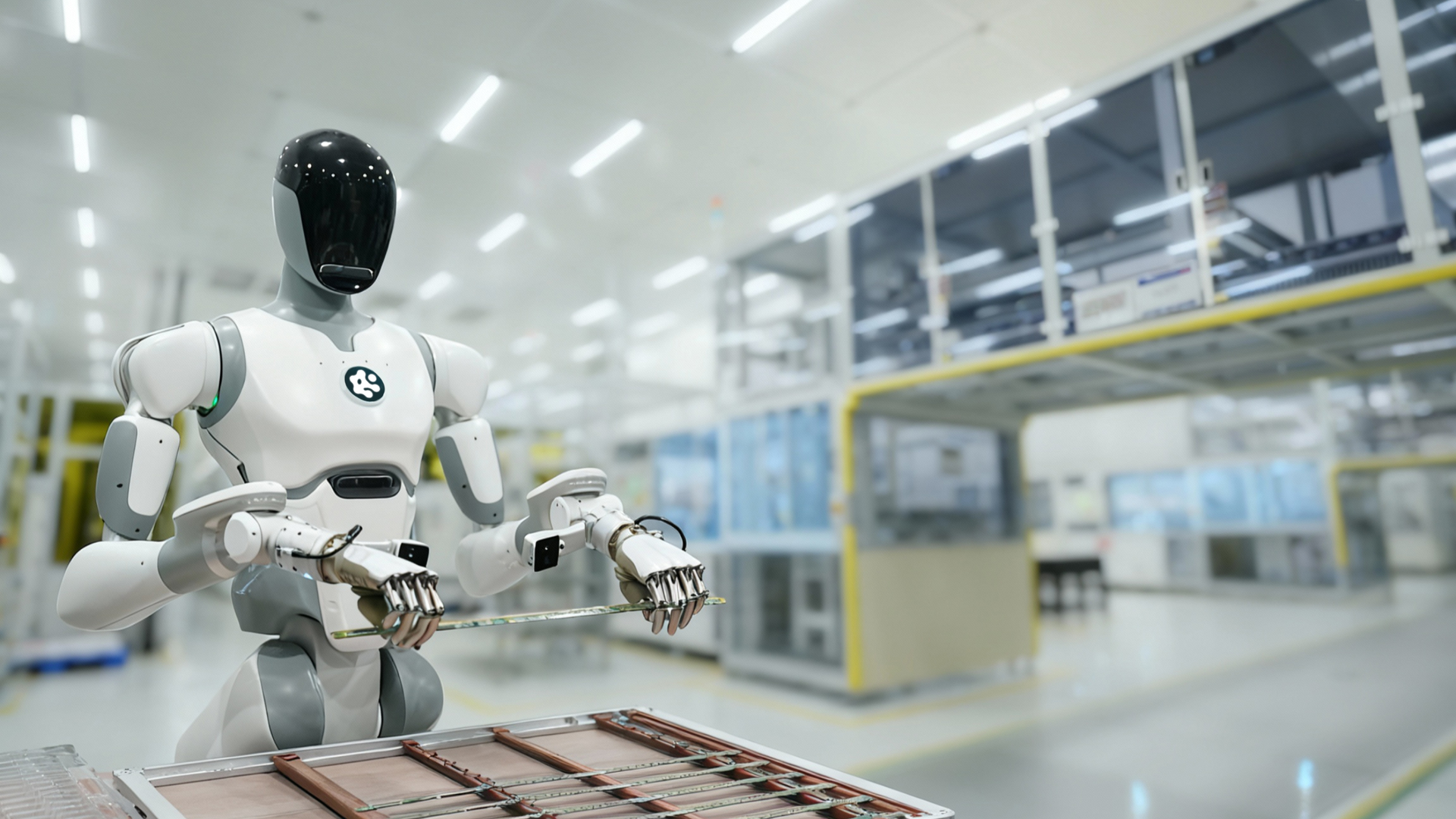
Shenzhen-based AI² Robotics develops its flagship AlphaBot series of general-purpose robots to navigate and manipulate objects in complex, real-world environments like factories, laboratories, and households. Photo from the official website of AI² Robotics

Southern China’s Greater Bay Area (GBA) has minted two highly-valued embodied intelligence unicorns, each reaching a valuation of over 20 billion yuan ($2.9 billion), adding to the country’s list of most valuable startups advancing physical artificial intelligence (AI).

Shenzhen-based general-purpose robotics startup AI² Robotics announced on Monday (June 30) that it hit a new valuation milestone of over 20 billion yuan after raising almost 5 billion yuan ($735.9 million) in new financing.

The fresh capital saw the startup double its valuation in roughly four months. It was valued at 10 billion yuan ($1.5 billion) upon the completion of a Series B round at 1 billion yuan ($147.2 million).

Although AI² Robotics did not confirm any listing plans, its completion of a joint-stock reform in April is widely viewed as its move towards an initial public offering (IPO). By establishing the legal and structural prerequisites required by the China Securities Regulatory Commission (CSRC), the joint-stock reform typically serves as the essential first step for an IPO.

On the same day, X Square Robot, another Shenzhen-based startup developing proprietary embodied AI “brains” and wheeled humanoid robots, confirmed that its valuation crossed 20 billion yuan after closing four Series B to C-stage funding rounds over the past two months.

X Square Robot is reportedly considering an IPO in Hong Kong to raise approximately $500 million.

Both startups are headquartered in the southern Chinese tech-heavy megacity of Shenzhen, which is part of the so-called Greater Bay Area, consisting of nine mainland Chinese cities and the Special Administrative Regions (SARs) of Hong Kong and Macao.

The GBA is home to 80 Chinese unicorns, or startups founded in the 2000s and worth at least $1 billion, representing a net increase of eight unicorns compared to last year, according to the Global Unicorn Index 2026 released by the Hurun Research Institute on June 25.

The region, designed to rival Silicon Valley by combining massive manufacturing scale with robust capital markets, accounts for just over a fifth of the country’s 381 unicorns, surpassing the total counts of South Korea and Japan combined.

The global AI super-charge is giving rise to a new breed of mega-corporations at an unprecedented speed. As the battleground shifts towards physical AI commercialisation and deployment at scale, Chinese startups like AI² Robotics and X Square Robot are resorting to a wider scope of financial and strategic investors to fuel their next phase of growth.

Over the years, X Square Robot has brought together a mix of professional private market funds, including HSG, IDG Capital, Source Code Capital, and CICC Capital. It claims to be the only embodied AI startup in China to have secured lead-round backing across different stages from four of the country’s tech giants, namely Alibaba Group, ByteDance, Xiaomi, and Meituan.

Its latest four funding rounds also roped in industry capital from companies like online marketplace 58.com Inc, automaker Chery Automobile, and smartphone brand Honor, offering opportunities to potentially apply its embodied AI in automobile manufacturing, consumer electronics, and household services.

As for AI² Robotics, its diverse group of investors spans state-level and regional-level government funds, various local investment firms, and domestic insurers. Industry players including Sino Biopharmaceutical, tech giant Baidu’s strategic investment arm, and the state-owned baijiu brand Kweichow Moutai and rolling stock manufacturer CRRC Corp are also among its shareholders.

As AI becomes more embedded in both digital and physical realms, China’s manufacturing strengths and innovation ecosystem are forming the backbone of global AI hardware.

“China’s AI is entering a new phase–one defined less by catching up in capability and more by capturing value. The narrative has shifted decisively from training to inference, from technology to application, and from potential to real earnings. Rather than competing purely at the frontier, China is optimising for speed, cost efficiency, and system-level integration, enabling AI to diffuse rapidly across the real economy,” researchers at Morgan Stanley noted in a May 2026 report.

“While enablers and foundational models remain the key investment thesis at the current stage, widespread adoption brings potential investment opportunities to those who reap the fruits of AI.”

Morgan Stanley estimates that AI could lift China’s total factor productivity growth by approximately three percentage points cumulatively over the next decade, partly offsetting the ageing population and bringing 2035 potential GDP to a level 3.5 percentage points higher than the trajectory without AI adoption.

Between January 1 and June 4, a total of 226 Chinese embodied intelligence and robotics startups collectively raised over 46 billion yuan ($6.8 billion) across 288 deals, according to Chinese data service provider IT Juzi.

The capital is heavily concentrated in the hands of a few, with the 10 biggest fundraisers during the period, including Spirit AI, Galaxea AI, Galbot, and LinkerBot, collectively pocketing 24.2 billion yuan ($3.6 billion), or 52.6% of the sector’s funding total.

Edited by: Pramod Mathew

Bring stories like this into your inbox every day.

Sign up for our newsletter - The Daily Brief
Subscribe to Newsletter


This is your last free story for the month. Register to continue reading our content