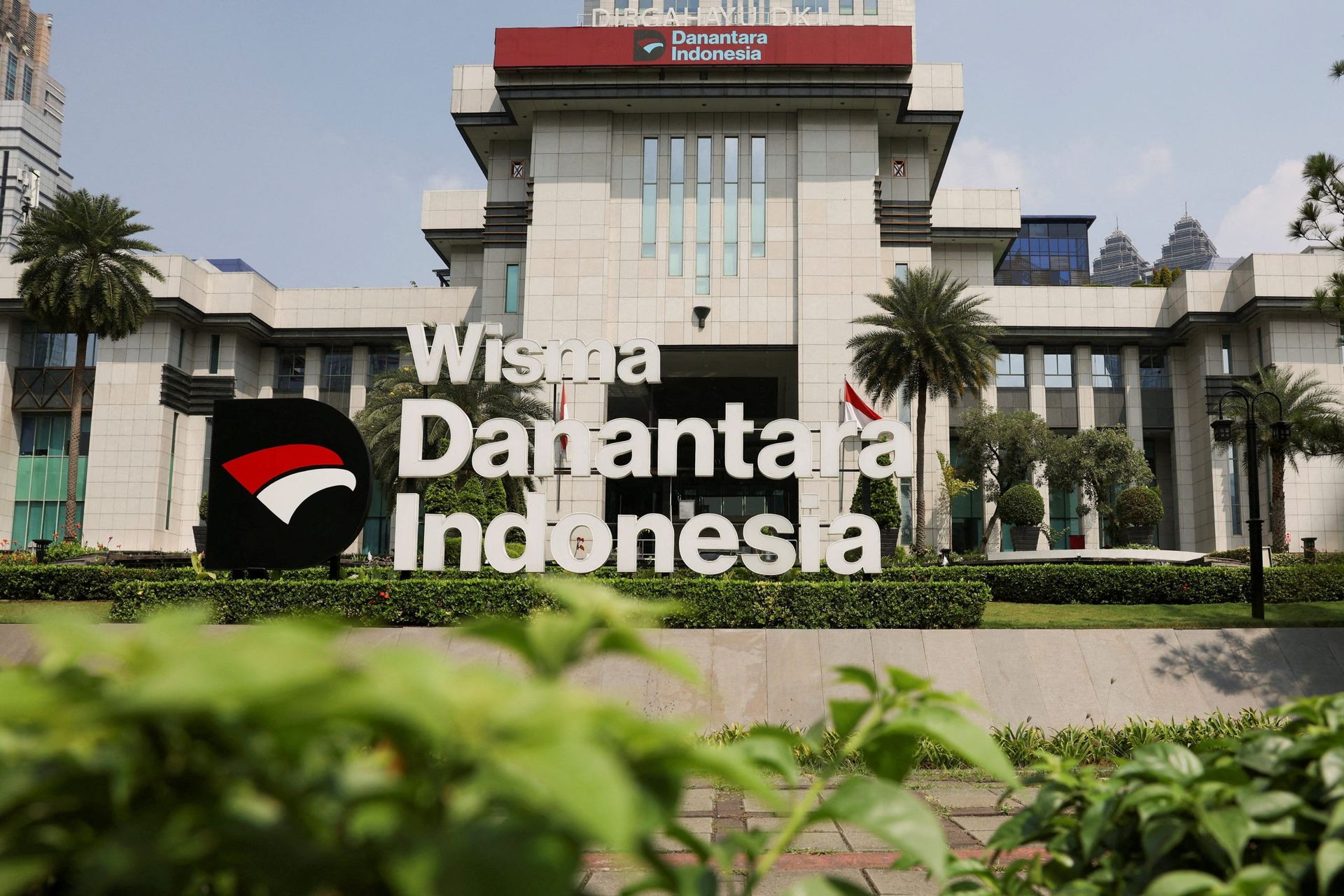
Indonesia’s sovereign wealth fund Danantara reported a consolidated net profit of 203.4 trillion rupiah ($11.1 billion) for the nine months ended December 2025, in its first financial filing since its establishment in late February.
The audited results cover April to December, following the transfer of state-owned enterprise (SOE) shares to Danantara in March 2025. Revenue reached 2,385.2 trillion rupiah ($130.1 billion), while net cash flow from operating activities stood at 563.1 trillion rupiah ($30.7 billion).
Operating profit reached 390.4 trillion rupiah ($21.3 billion), while profit before tax stood at 292.7 trillion rupiah ($16 billion).
For the full year, Danantara reported pro forma revenue of 3,073 trillion rupiah ($167.5 billion), EBITDA of 704.7 trillion rupiah ($38.4 billion) and net profit of 259.6 trillion rupiah ($14.1 billion).
The full-year figures are pro forma, reflecting the consolidation of SOEs into Danantara from January 1, 2025, and are unaudited.
The fund said its first year was largely spent building its organisation, strengthening its team and consolidating its portfolio. Its next phase will focus on expanding investment activities and improving the performance of state-owned enterprises (SOEs).
Danantara’s consolidated assets stood at 11,607 trillion rupiah ($632.8 billion) as of December 31, up 5% from 11,051 trillion rupiah ($602.5 billion) at the end of March.
Its equity increased 5.6% to 2,980 trillion rupiah ($162.4 billion) over the same period. Return on equity was 8.7% on a 12-month pro forma basis.
The results provide an initial picture of the scale of Danantara’s balance sheet, but improving the profitability of its portfolio remains a key challenge, since it is heavily dependent on a small number of state-owned enterprises.
Around 90% of the group’s profit is generated by six SOEs, while financial institutions account for approximately half of its assets.
Profitability remains a challenge
Herry Gunawan, director of NEXT Indonesia Center, an independent economic, social and public policy research institution, said Danantara’s financial performance appeared positive when viewed on a consolidated basis with the SOEs under its management.
However, he said the fund still had significant room to improve its profitability.
Danantara’s full-year net profit represented around 8.45% of its revenue, compared with a 17% net profit margin at Singapore’s Temasek Holdings over the same period.
Temasek recorded a net profit equivalent to 331.2 trillion rupiah against revenue of 1,948.1 trillion rupiah, according to figures cited by Gunawan in comments to DealStreetAsia.
The comparison is not like-for-like, as the two institutions have different portfolio compositions and business models.
Gunawan said several factors were weighing on Danantara’s profitability, including operational and production inefficiencies among its portfolio companies. Around 52% of SOEs reported losses, making their financial performance a drag on the consolidated results, he added.
Danantara also carries interest-bearing debt of 1,604 trillion rupiah, which could constrain its ability to generate sustainable returns if financing costs remain elevated.
“Danantara needs to immediately demonstrate concrete steps towards internal efficiency to boost profitability,” Gunawan said.
Danantara’s financial statements showed total liabilities of 8,331 trillion rupiah at the end of 2025, alongside interest-bearing debt of 1,604 trillion rupiah.
It has said it would continue to monitor its debt-to-equity ratio and other financial indicators to manage risks associated with its consolidated portfolio.
The release of Danantara’s first financial statements has drawn criticism from Danantara Monitor, a civil society coalition that includes CELIOS, Indonesia Corruption Watch and Transparency International Indonesia. The coalition said aggregate figures were insufficient for the public to assess how state assets are managed and how investment decisions are made, as it said in a statement.
It called for more disclosure on investment flows and project performance, including in the energy sector, and questioned the delay in publishing the accounts.
CELIOS executive director Bhima Yudhistira questioned the due diligence behind Danantara’s project selection, citing CIO Pandu Sjahrir’s statement in an Instagram post that the fund had analysed more than 600 projects in 2025, of which 39—or about 7%—had been signed. Yudhistira also criticised Danantara’s return on equity, citing funding support from Patriot Bonds and SOE dividends.
Danantara Monitor acknowledged the complexity of consolidating more than 1,000 companies, but said that should not prevent regular updates on the reporting process. It also urged Danantara to explain the delay and provide more information on its investment strategy and energy-transition commitments. These are the coalition’s criticisms and demands, not findings of a regulatory breach.
Financing offers potential to support growth
Gunawan said Danantara’s financing activities were significant given the relatively small role of the public sector in Indonesia’s investment financing.
According to Bank Indonesia data cited by Gunawan, the government and SOEs accounted for around 14% of total realised investment financing.
Danantara’s financing reached 3,998.9 trillion rupiah at the end of 2025, up 267 trillion rupiah from March. Its investments in securities rose 11.1% to 1,485.9 trillion rupiah.
Gunawan said the financing could help increase the productive capacity of the economy and, ultimately, improve the profitability of companies receiving the funds.
During a media briefing on Wednesday in Jakarta, Pandu Sjahrir, Danantara’s CIO and CEO of Danantara Investment Management (DIM), said the fund would maintain sufficient liquidity while mobilising capital for investments.
Funding would partly come from dividend contributions from Danantara’s asset management arm (DAM), alongside third-party funding through bonds and other instruments.
He said the fund would maintain a prudent approach to investment, including managing risk, keeping its cost of capital competitive and diversifying its portfolio.
Danantara is pursuing investments in waste-to-energy, data centres, downstream industries and energy transition projects.
Some of these investments, however, will take several years to generate returns, Sjahrir said. Waste-to-energy and other projects would require around four to five years before they could begin contributing dividends to DIM.
Consolidation provides foundation for investment
Danantara’s financial results come as it continues to consolidate more than 1,000 entities, including hundreds in which it holds minority stakes.
Danantara’s CEO Rosan Roeslani said the fund’s first six months were largely spent building its institutional capabilities and strengthening its team. Danantara began with just three people and recruited 313 professionals during 2025, he said.
The consolidation process involves aligning accounting standards, eliminating intercompany transactions and reviewing the underlying financial position of portfolio companies.
Danantara’s managing director finance Arief Budiman said Danantara had prioritised establishing a sound financial foundation in its first year, including reviewing the financial position of its portfolio companies.
Danantara’s COO and DAM CEO, Dony Oskaria, said the review also covered impairment adjustments relating to previous financial years, with the aim of producing more transparent financial statements.
The elimination process has been particularly time-consuming because of the number of companies involved, Oskaria said. Around 200 auditors from Indonesia’s Supreme Audit Agency (BPK) have been involved in the process since February.
Beyond its balance sheet, Danantara’s ecosystem paid 567.2 trillion rupiah in taxes during 2025. State capital participation allocations also declined to 4.7 trillion rupiah in 2025 from 54.6 trillion rupiah in 2022.
Danantara said it had begun developing more than 20 downstreaming projects worth around 225 trillion rupiah across energy, minerals and metals, and food and agro-industry.
Its asset management arm, Danantara Asset Management (DAM), is also streamlining the SOE portfolio. As of October 2026, 364 of approximately 1,074 SOE entities had been streamlined, toward a target of 250 to 300 entities. Danantara said the process could generate efficiencies of up to 50 trillion rupiah a year.
Danantara distributed 143 trillion rupiah in dividends from SOEs in 2025, of which 11.8 trillion rupiah was paid to the government. It is targeting dividend income of 140 trillion rupiah to 160 trillion rupiah in 2026, subject to portfolio performance.
For 2026 and 2027, Sjahrir said the initial drivers of profitability for DIM would be public market investments and treasury activities, alongside dividends from existing SOEs.
Private investments would focus on assets capable of generating cash flow and dividends, while projects such as waste-to-energy facilities would require a longer investment horizon.
DIM is targeting $3.8 billion, or around 69 trillion rupiah, in private investments to be deployed and signed in 2026. As of October, total investment assets stood at around 162 trillion rupiah, including 60.6 trillion rupiah in public investments.
The fund’s announced projects include the national waste-to-energy programme across 33 cities and regencies, with a total value of around 40 trillion to 50 trillion rupiah and DIM investment of about 10 trillion rupiah. Its other investments include the acquisition of Novotel Thakher Makkah, a chemical project in Indonesia and a 25% stake in JBS’s protein business in Australia and New Zealand.
Danantara’s results offer an initial view of the scale of its portfolio. Its ability to deliver stronger returns will depend on the financial performance of its SOEs, the pace of consolidation and whether new investments can generate sustainable income.