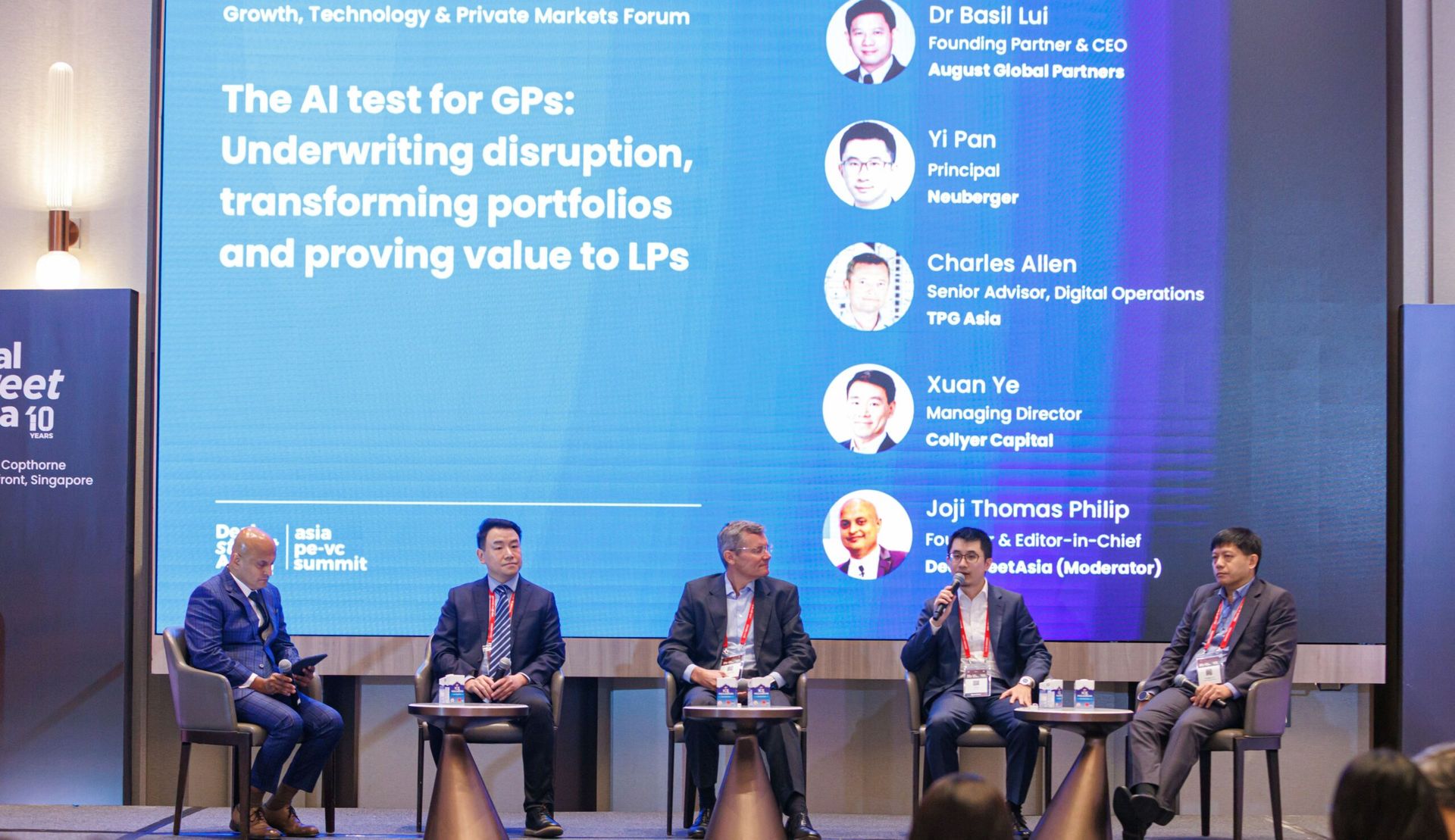
While AI is making processes faster and, in some cases, improving the efficiency of fund managers’ operations, private markets investors cautioned against overstating the technology’s impact on investment outcomes and portfolio companies.
Speaking at DealStreetAsia’s recent Asia PE-VC Summit 2026, investors said AI is increasingly becoming a useful tool across the investment lifecycle, from underwriting and operational efficiency to portfolio management, but it does not replace human judgement, relationships and sector expertise that underpin private markets investing.
For one, its impact on portfolio companies can be overstated, particularly when it comes to the ability to bring in new clients or drive revenue growth, according to Xuan Ye, Managing Director at Collyer Capital.
At the same time, the technology could introduce new risks for current businesses as AI lowers barriers to entry.
If AI can start commoditising, new competitors can take advantage of it, and existing businesses might see valuation multiples going down despite still generating revenues if they do not keep themselves abreast [of new developments], added Basil Lui, Founding Partner & CEO of August Global Partners.
For Lui, who focuses on healthcare and bioscience investments, AI is therefore only one factor to consider when evaluating businesses in the sector. Other considerations include the strength of a company’s moat across its vertical stack, manufacturing, assembly and packaging capabilities, distribution network, established customer relationships and proprietary networks.
“With AI, we have to continually check our underlying assumptions and make sure that our companies are ahead of competitors,” he said. “The first-mover advantage [in the sector] helps because we can inform the portfolio companies to expand their products and services into other areas.”
Acknowledging AI’s role
There are, however, areas where AI can go beyond simply speeding up existing processes and provide investors with new perspectives on potential deals.
Charles Allen, Senior Advisor, Digital Operations, at TPG Asia, cited the example of a potential merger between two businesses where cultural fit was a key concern. TPG was able to build a model using data from the two companies to assess the integration plan in greater detail, helping the investment team develop greater conviction around whether the businesses could be successfully combined.
The example reflects a broader effort by TPG to embed AI capabilities into its investment process through Lab39, its AI operations unit.
By capturing all of the characteristics during the investment process, with every deal, the firm can get a perspective based on the characteristics of the deal along with a retrospective view.
“That is a helpful starter [which] allows us to do pattern matching with previous deals that we invested in, as well as deals that we did not invest in,” Allen said. The objective, he said, is to build intelligence and tools that can sit underneath human judgement and give investment teams “a leg up” in evaluating opportunities.
The benefit of AI in cost optimisation and streamlining operations is certainly recognised.
“PE, VC firms are not in the business of solving Navier-Stokes equations. We just need a good enough model,” Lui said, adding that firms could hire good AI-native analysts to challenge the model.
However, he emphasised the responsibility of investment committees for the final decision, as there must be “the human in the loop”.
The LP narrative
The same principle applies to limited partners (LPs), as they value human interaction in assessing the managers.
Underwriting and investing in general partners (GPs) takes even longer than the private equity fund life itself, according to Yi Pan, Principal at Neuberger.
While AI can provide LPs with large amounts of information about what the industry knows historically, on a go-forward basis, “it is the human judgment that matters to long-term investments,” he said.
In private markets where data could be opaque and one-sided, proprietary networks are among the most important areas that AI cannot replicate.
For example, if LPs have a large-enough GP universe, they can gain a more comprehensive view of the same underlying companies that several fund partners invest in, as noted by Pan.
Information from GPs they have worked with in the past or from co-investments they have made could also help investment teams make better-informed decisions and build greater conviction, Pan added.
For SE Asia specifically, a region where things work better based on having relationships, the impact of AI on LP-GP dynamics remains limited, according to Ye. “AI is not going to bring in good deals. It’s more based on human relationships, industry insights, and the capacity to connect with founders and family-run businesses in the region,” he said.