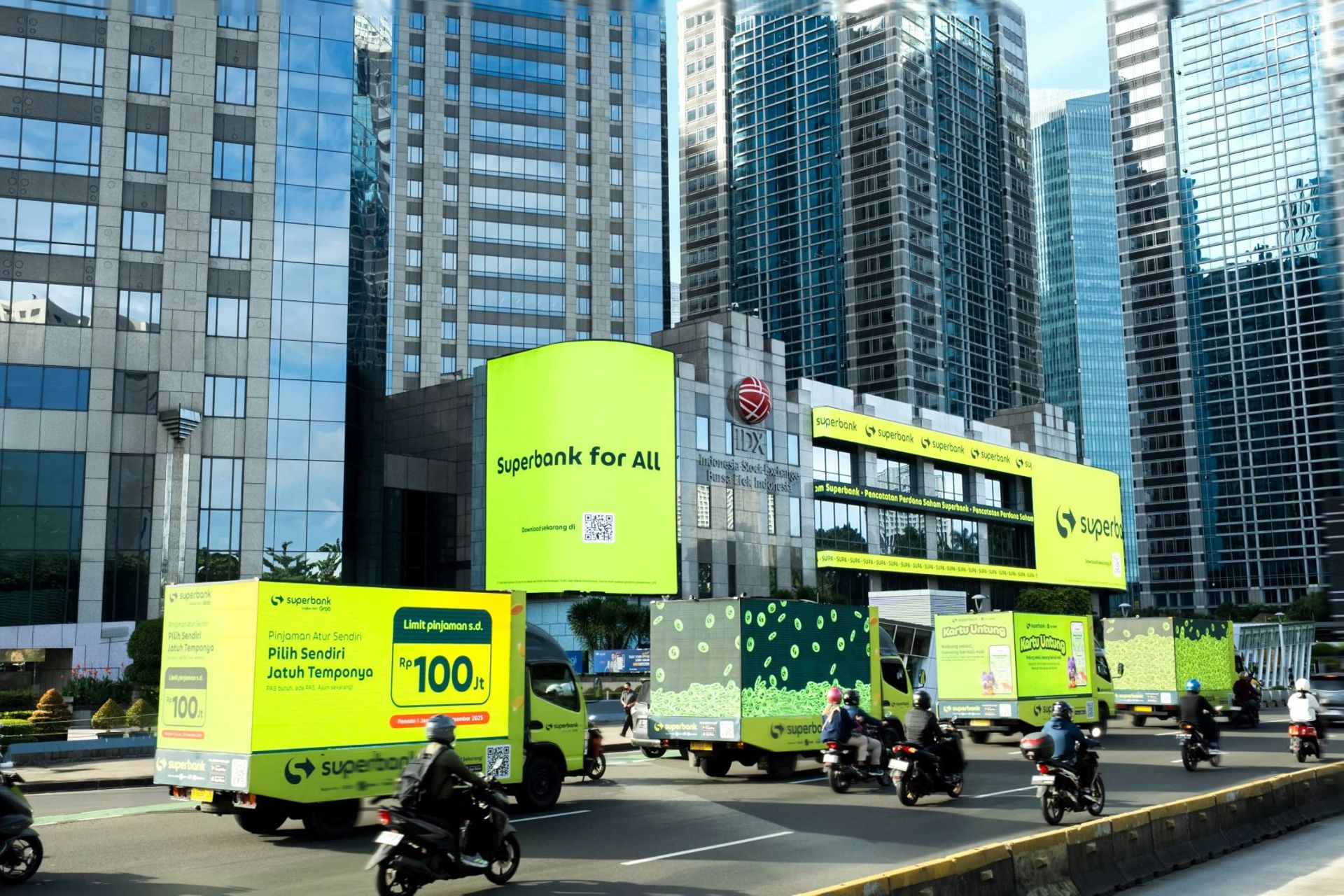
Grab-backed, Indonesia-listed digital bank Superbank reported stronger quarterly earnings in the second quarter, supported by robust loan growth across the Grab and OVO ecosystem, while continuing to improve profitability and asset quality.
The digital bank posted a pre-tax profit of 134 billion rupiah ($7.4 million) in the April-June quarter, up 33.5% from 100 billion rupiah ($5.5 million) in the first quarter. Total assets also expanded 12.8% from the end of March.
For the six months ended June 30, Superbank booked a pre-tax profit of 234 billion rupiah ($13 million), more than seven times higher than a year earlier. Net profit rose to 182.6 billion rupiah ($10.1 million) from 20.5 billion rupiah ($1.13 million) in the first half of 2025, while net interest income increased 52% year on year to 1.01 trillion rupiah ($56 million). Total assets reached 27 trillion rupiah ($1.5 billion).
“The first half of 2026 marks an important milestone for Superbank. The ecosystem strategy we have built together with our shareholders is now delivering tangible results, not only in expanding our customer base, but also in strengthening our profitability, operational efficiency, and asset quality,” President Director Tigor M. Siahaan said.
“This demonstrates our ability to build growth that is not only fast, but also healthy and sustainable. Going forward, we will continue to deepen collaboration across our ecosystem to deliver digital financial services that are more relevant, accessible, and capable of creating long-term value for our customers, partners, and shareholders,” he added.
The bank’s loan portfolio grew to 13.4 trillion rupiah at the end of June, up 61% from a year earlier and 17.6% from the previous quarter, driven by broader integration of its Pinjaman Atur Sendiri (PAS) lending product into the Grab and OVO ecosystem.
The bank said embedding PAS into OVO in mid-March helped lift incoming loan applications by 94% by the second quarter. Third-party funds climbed 89.1% year on year and 10.3% quarter on quarter to 15.9 trillion rupiah, outpacing loan growth and reinforcing the lender’s liquidity position. Superbank said it served more than 7 million customers as of June, with more than 60% coming from the Grab and OVO ecosystem.
Customer activity also continued to increase. Total digital customers reached 7.4 million in June, up 86% from a year earlier, while daily transactions rose 168%. QRIS transaction volume jumped 477% year on year, and transaction value increased 379%, while OVO Nabung transaction volume and value grew 123% and 99%, respectively.
The earnings come after Grab completed a restructuring of its investment in Superbank, becoming the digital lender’s controlling shareholder. As of June 30, entities under Grab Holdings—including GXS Bank, PT Kudo Teknologi Indonesia and A5-DB Holdings—collectively owned 50.9% of Superbank, while Emtek held 27.7% through PT Elang Media Visitama and KakaoBank owned 8.7%.
As part of the restructuring, GXS Bank acquired 2.45 billion Superbank shares from Singtel Alpha Investments on May 29, increasing its direct stake to 17.66% from 10.44%, according to an OJK filing submitted on June 11. Superbank said its financials have been consolidated into Grab’s since May 31.
Asset quality also strengthened, with the gross non-performing loan ratio improving to 1.6% from 2.7% a year earlier, while the capital adequacy ratio remained at a robust 74.5%, according to the company.
The financial statements, however, show the bank continued to build credit loss reserves as lending accelerated. Impairment losses on financial assets rose to 246.1 billion rupiah in the first half from 136.1 billion rupiah a year earlier, reflecting higher provisioning against potential future loan losses as its loan book expanded.
Over the same period, gross loans increased to 13.4 trillion rupiah from 9.6 trillion rupiah at the end of 2025, while the allowance for impairment losses rose to 454.3 billion rupiah from 418.7 billion rupiah.
Separately, the bank recovered 5.8 billion rupiah from loans that had previously been written off, compared with 6.9 billion rupiah in the corresponding period last year.