Indonesia’s sovereign wealth fund, Indonesia Investment Authority (INA), is broadening its investment strategy as it seeks to move beyond its initial portfolio-building phase, expanding into new investment areas while taking a more active approach to portfolio management under a new leadership team.
Dubbed INA 2.0 for term 2026-30, the changes reflect INA’s effort to evolve from primarily deploying capital into strategic domestic assets towards a more active institutional investor that manages a broader mix of investments and investment structures.
The move reflects how INA’s priorities have evolved since it was established in 2021. After spending its first five years building an investment portfolio and bringing foreign investors into Indonesia, the agency is now looking to widen its investment opportunities, rely more on indirect investments, and take a more active approach to managing its portfolio.
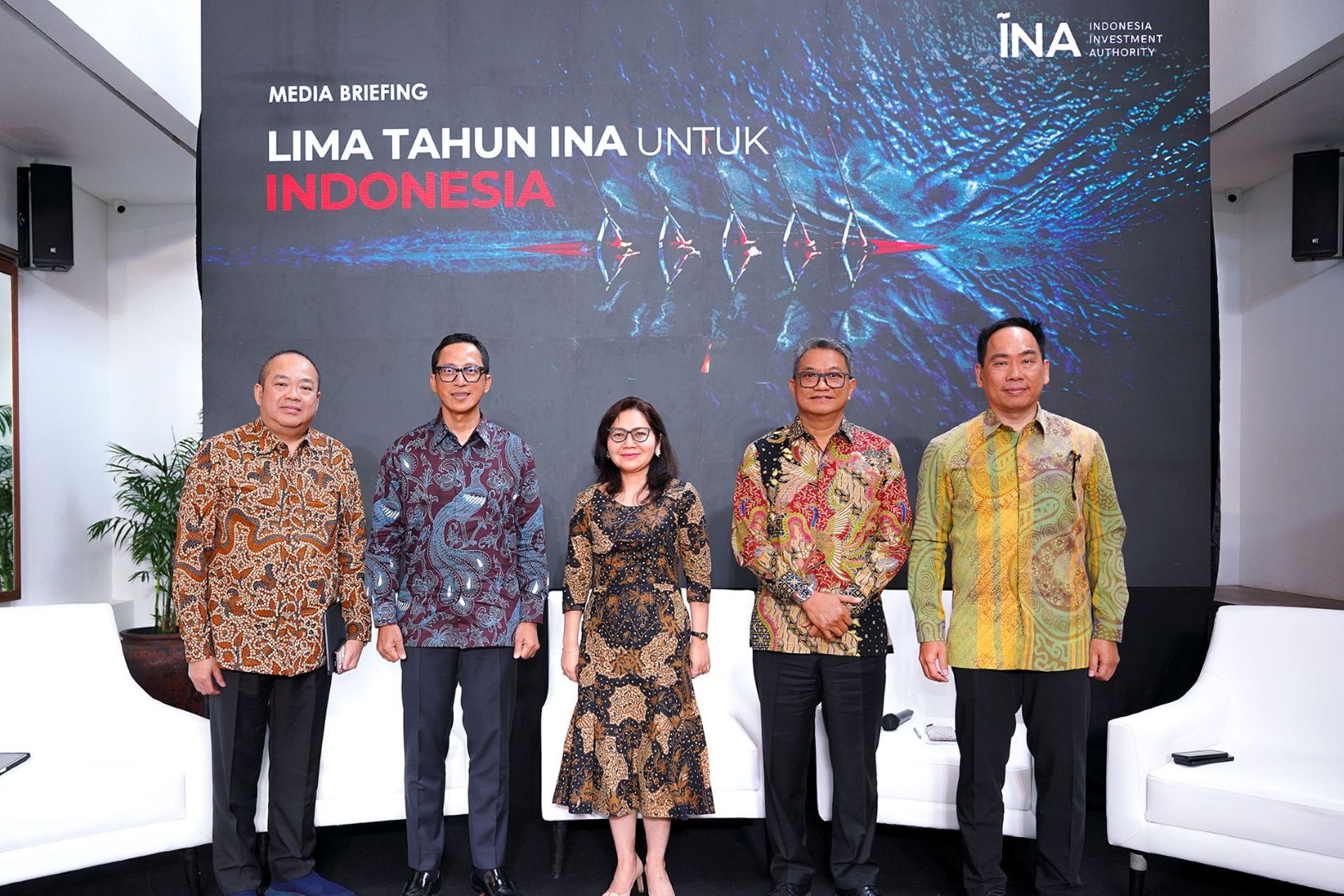
At a media briefing on Wednesday, INA also formally introduce its new leadership team, led by chief executive Oki Ramadhana who succeeded Ridha Wirakusumah; Laksono Widodo as chief investment officer; and Adhiputra Tanoyo as chief risk officer.
“My KPI for the next five years is very simple: to make INA much bigger, with investments that are more impactful, more optimal, and generate much larger returns than today,” Ramadhana told reporters.
“We need to remain a catalyst for Indonesia’s development by bringing more global capital into the country. To do that, we have to be more optimal and more creative.”
Under the new strategy, INA will continue investing in healthcare, transportation and logistics, green energy, and digital and artificial intelligence while expanding into advanced materials and selectively pursuing manufacturing-related opportunities.
It also plans to increase indirect investments through strategic limited partner (LP) and co-general partner (co-GP) structures while rebalancing its portfolio to improve long-term returns without sacrificing liquidity.
Other sectors, including education, consumer, financial services and business services, will continue to be explored on an opportunistic basis.
Chief Legal Counsel Arisia Pusponegoro said the agency evaluates a sector extensively before deciding to invest, citing advanced materials as an example. She said the decision to expand into that sector followed extensive research into Indonesia’s competitive advantages rather than short-term market trends.
“Before we entered advanced materials, we studied the market, the value chain, where Indonesia has competitive advantages, where the potential projects are, and who the strategic partners could be,” she said.
“So when we enter a new sector, we already know where the opportunities are. The decision is based on data and real project potential, not simply because a sector looks attractive.”
The agency will also make greater use of indirect investments through global fund managers to broaden its investment pipeline and create more co-investment opportunities in Indonesia. At the same time, INA will continue rebalancing its portfolio by increasing exposure to higher-yield asset classes, including private equity, hybrid capital solutions and real estate, while maintaining liquidity and managing risks.
Chief financial officer Eddy Porwanto said INA formally reviews every investment thesis at least twice a year to assess whether underlying assumptions remain valid as market conditions evolve.
“Every investment thesis is formally reviewed at least twice a year. If there are new uncertainties or changes in the business environment, we need to adjust,” he said. “We invest mostly through equity, so risks will always exist. The key is to stay agile and make the necessary adjustments so new risks can be mitigated.”
Porwanto said the reviews involve the investment, valuation, legal and risk management teams to determine whether each investment remains on track or whether changes are needed.
“The stronger the governance, the more it helps manage uncertainty, both for us and for our investment partners,” he added.
Ramadhana said INA would also become more proactive in identifying investment opportunities instead of waiting for transactions to come to market.
“The capital is already there. Our job now is to identify opportunities, structure them properly, and make sure they are commercially viable while creating impact for Indonesia,” he said.
Financial performance
The new strategy comes after INA expanded its assets under management to 146.2 trillion rupiah ($9.1 billion) by the end of 2025, nearly double the level at its inception. Cumulative investment deployment alongside its partners reached 74.5 trillion rupiah ($4.7 billion), including 33.3 trillion rupiah ($2.1 billion) invested directly by INA and 41.2 trillion rupiah ($2.6 billion) in foreign direct investment mobilised into Indonesia.
Infrastructure, transportation, and logistics remained the largest destination for INA’s investments, accounting for 44% of cumulative deployment between 2021 and 2025. Digital and digital infrastructure represented 29.6%, followed by green energy and energy transition (9.8%), healthcare (9.2%), and advanced materials (5.5%).
INA also reported stronger earnings in 2025. Revenue rose 44.6% year on year to 8.45 trillion rupiah, while net profit increased 37.3% to 7.45 trillion rupiah, driven by higher dividend income, interest income, and unrealised gains from investments in subsidiaries.
At the end of the year, INA’s total assets were largely unchanged at 110.99 trillion rupiah, while liabilities fell 15.4% to 2.77 trillion rupiah after the agency repaid its bank borrowings, lifting total equity to 108.22 trillion rupiah.
Since its establishment in 2021, INA has secured about $25 billion of investment commitments from 40 strategic partners across 15 countries while maintaining investment-grade ratings of BBB internationally and AAA(idn) domestically. It also achieved a Governance, Sustainability and Resilience score of 72% in an independent Global SWF assessment, above the global sovereign wealth fund average of 53%.