Private funding for Southeast Asia’s digital applications sector has stabilised at about $8 billion annually, according to the 11th e-Conomy SEA report by Google, Temasek, and Bain & Co.
Companies with core AI products captured 80% of private funding deal value of $3.2 billion in the first half of 2026, up from 30% in the second half of 2024, highlighting the growing concentration of investment in AI-related businesses.
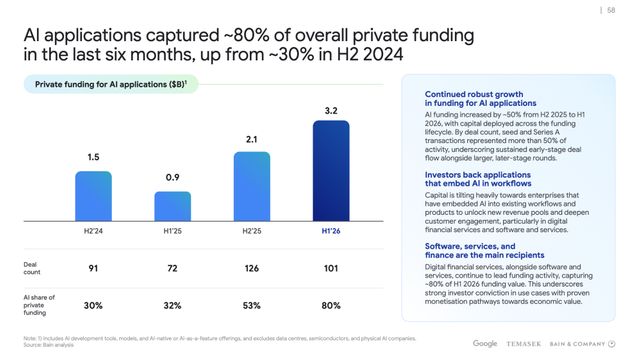
Investment is also flowing into the infrastructure needed to support AI development.
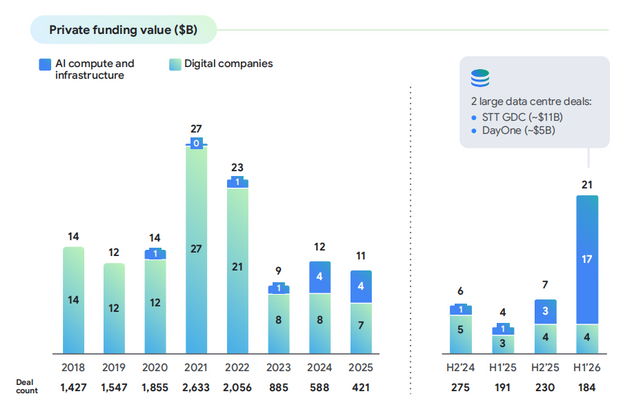
Private capital deal value in AI compute and digital infrastructure reached $20 billion over the past 12 months, led by the $11-billion acquisition of ST Telemedia Global Data Centres, according to the report.
“AI will create significant opportunities for Southeast Asia’s economy. However, translating adoption into sustainable growth will require strong governance, disciplined execution, and resilient business models,” said Fock Wai Hoong, head of Asia Pacific excluding China and India at Temasek Global Investments.
Google’s managing director for Southeast Asia and South Asia Frontier Markets, Nitin Gajria, said the region could become a leader in agentic commerce, in which AI systems can carry out tasks on behalf of consumers.
“Unlocking that full potential will require clear governance, transparent capabilities, and an unwavering commitment to responsible AI deployment across the whole ecosystem,” he said.
AI infrastructure and digital champions are driving investment growth
Singapore as SE Asia’s AI hub
Singapore is consolidating its position as Southeast Asia’s leading AI and digital infrastructure hub, with its digital economy projected to reach $31 billion in gross merchandise value in 2026, up 8% year-on-year, and $59 billion by 2035.
The report said generative AI penetration in the city-state has reached 70% of the working population, or about 3.2 million people, while most of the region’s AI infrastructure funding has gone to platforms headquartered in the city-state.
Singapore is also seeking to meet rising computing demand while managing its environmental impact, allocating an additional 200 megawatts of green energy to support its 1.4-gigawatt computing base.
Government initiatives include a framework to govern agentic AI and a programme to train 100,000 people by 2029.
“Singapore’s AI maturity is the result of deliberate, sustained investments across infrastructure, talent, and governance,” Gajria said, adding that the country could serve as a proving ground for the safe and responsible deployment of AI agents across Southeast Asia.
The report covers 10 Southeast Asian markets and five core digital economy sectors: e-commerce, online travel, online media, mobility and food, and digital financial services.
Digital economy
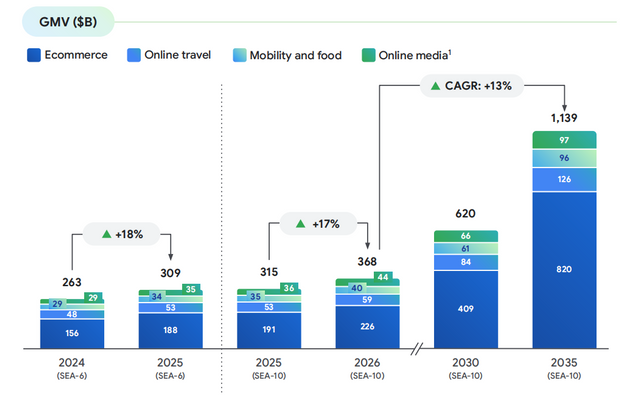
Southeast Asia’s digital economy is projected to grow 17% year-on-year to reach $368 billion in gross merchandise value (GMV) this year and is on track to surpass $1 trillion by 2035, per the report.
The massive GMV growth comes as artificial intelligence (AI) adoption expands and attracts investment, the report said.
“Southeast Asia’s AI story is shifting from how many people use it to how deeply they use it,” said Florian Hoppe, a partner at Bain & Company. “Closing that gap will drive the next wave of growth.”
The latest e-Conomy SEA report found that 243 million people, or 58% of the working population across the region’s six largest markets, had adopted generative AI in less than three years.
However, AI usage per capita remains about 10% of US levels, indicating that adoption has yet to translate into deeper usage and widespread commercial returns.
The report estimates that regional AI usage could increase as much as 60-fold by 2030 as users move from basic queries to more complex tasks and AI agents.
SEA’s digital economy sustains its growth trajectory
Consumers currently account for about 60% of regional AI usage, while enterprise workloads are more established in Singapore and Malaysia, where they account for 45% to 60% of usage.
AI is also reshaping consumer-facing digital businesses.
E-commerce GMV is projected to reach $226 billion in 2026, up 18% year-on-year, while online travel GMV is expected to rise 10% to $59 billion.
Online media revenue is forecast to grow 22% to $44 billion, and mobility and food delivery GMV is projected to increase 15% to $40 billion.
In e-commerce, the report noted that 69% of consumers use AI to compare products, while 93% trust AI recommendations in their purchasing journeys.
Businesses are also seeing measurable benefits, with AI enhancements contributing to a 10% year-on-year improvement in conversion rates in one case and increases of up to 75% in average order value.
“Growth dynamics are now firmly rooted in the value AI brings to interactions between businesses and consumers,” the report said.