Vietnamese specialty coffee chain Every Half Coffee Roasters has raised $8 million in a Series A funding round from existing investors Openspace Capital and DSG Consumer Partners, as the startup doubles down on store expansion, supply chain investments, and packaged coffee products.
The latest raise follows a $3 million pre-Series A round led by Openspace Capital with participation from DSG Consumer Partners last year, and an undisclosed seed investment from the same backers in August 2024.
Founded in 2021 by CEO Vo Duy Phu and COO Tran Le Minh Truc, Every Half has expanded its network from 14 stores a year ago to 36 outlets currently—a 157% year-on-year growth—across Ho Chi Minh City and Hanoi, Danang and Hoi An, amid rising interest in Vietnam’s premium coffee segment. The management expects revenue to nearly triple this year as new stores mature.
The founders previously worked together at The Coffee House, where Phu served as co-founder and vice president while Truc led coffee sourcing and quality assurance before launching Every Half with the ambition of building a globally recognised Vietnamese specialty coffee brand.
“The first round was about proving the concept, the second round was about hitting milestones, and this third round happened because our investors kept seeing what we were doing,” Phu told DealStreetAsia in an exclusive interview.
The Series A capital will primarily be deployed to expedite domestic expansion while strengthening Every Half’s vertically integrated supply chain, which the company believes gives it a competitive advantage in an increasingly crowded coffee market.
“We have 36 stores today. Vietnam remains our key focus, and we want to quickly increase our presence in the domestic market,” Phu said.
The founder, however, told DealStreetAsia that he believes the opportunity extends beyond operating cafés. “We’re not just building a coffee chain,” Phu said. “We’re building a coffee company that works closely with farmers, owns fermentation technology, controls distribution and creates products across multiple channels. That’s what we believe will make the business sustainable over the long term… we’re investing much deeper into the supply chain because that’s where we believe we can build a long-term advantage.”
“We’re investing much deeper into the supply chain because that’s where we can build a long-term advantage.”
The company is also expanding its farming operations, with plans to increase managed farmland from around eight hectares currently to about 50 hectares over time to secure future supply and improve quality consistency through proprietary fermentation technologies.
Every Half plans to increase managed farmland to 10 hectares by the end of this year, the management said. The company also aims to expand directly supported coffee farms to around 18 hectares by 2026 through partnerships with local farmers and cooperatives.
“We meet a lot of coffee companies. Very few make you stop and pay attention the way Every Half does,” said Sameer Mehta, managing director at DSG Consumer Partners. “The founders have built something with real taste and real discipline—a rare combination—and we think they’re on their way to becoming one of the names that defines specialty coffee in Asia.”
Dennis Le, director and head of Vietnam at Openspace Capital, said the firm believes Every Half’s strengths across sourcing, processing, retail and consumer products position it well for long-term growth. “Every Half can be the brand that defines the future of Vietnamese coffee,” Le said.
Premium specialty coffee
Phu argues that Vietnam has historically exported coffee as a commodity while much of the value creation has occurred overseas. “Vietnam is the second-largest coffee producer in the world, but we’ve lost much of the value created from our own coffee,” he said.
As Vietnam’s coffee industry grapples with rising bean prices and climate-related supply constraints, Phu sees specialty coffee as an opportunity for local brands to capture more value from one of the country’s signature exports. He believes the segment remains under-penetrated despite Vietnam being the world’s second-largest coffee producer.
“Commercial coffee is becoming increasingly challenging as coffee prices continue to rise, while climate change is putting pressure on future supply,” he said. “We’ve deliberately chosen the premium specialty segment, where consumers appreciate quality, taste and the story behind every cup, rather than competing purely on price.”
“We’ve deliberately chosen the premium specialty segment, where consumers appreciate quality, taste and the story behind every cup, rather than competing purely on price.”
The founders are particularly betting on Vietnam’s emerging Fine Robusta segment, arguing that specialty-grade Robusta produced through selective harvesting and advanced processing techniques can reshape international perceptions of Vietnamese coffee, which has historically been viewed largely as a commodity export.
Every Half said it won a Gold award for its Fine Robusta at the Global Coffee Awards in Houston in 2025 and is also home to several Vietnam Barista Champions who have represented the country at the World Barista Championship.
Globally, the specialty coffee market is estimated to be worth around $183 billion and is expected to continue outpacing traditional coffee consumption, providing long-term growth opportunities for premium operators.
Packaged goods
Instead of relying primarily on retail outlets, Every Half is also diversifying into packaged goods and business-to-business distribution. The company now sells roasted coffee beans, brewing products and packaged coffee online, while also supplying hotels and other commercial customers.
“We don’t see stores as the only business model anymore,” Phu said. “Stores are touch points that introduce customers to the brand, but we’re also building e-commerce, delivery and consumer products as additional growth channels.”
Its consumer products business remains relatively small but has been growing about 20% month-on-month, according to the founder.
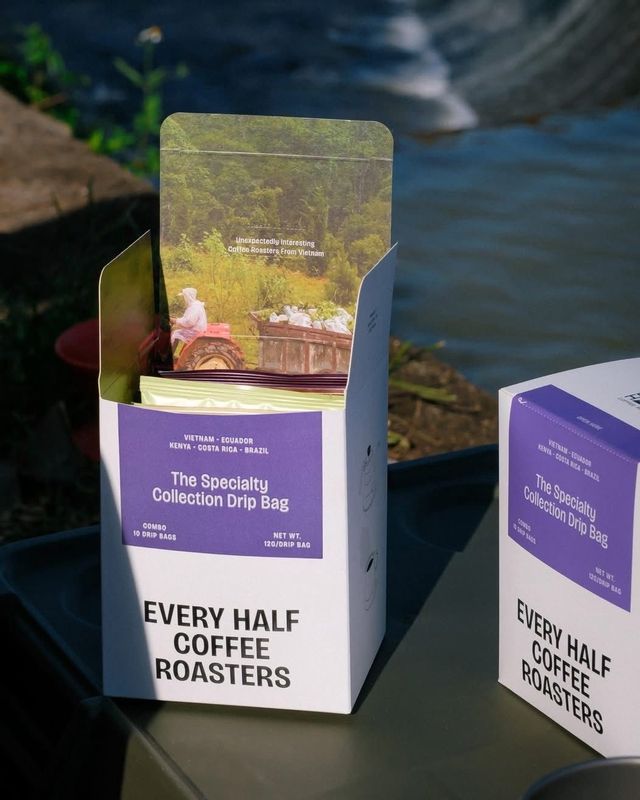
The startup also began selling on Amazon last year and now ships products to markets including Singapore, Thailand and Taiwan. The company also plans to expand further through modern retail channels and international distribution of its packaged coffee products.
“When we tested Amazon, we saw that our products were well received internationally,” Phu told DealStreetAsia. “Whenever we showcase Vietnamese coffee of high quality, we gain respect from international consumers.”
“We realised very early that we had to build strong fundamentals instead of growing recklessly,” he said. “The first three years were about building a traditional business with solid economics, and that has allowed us to scale without hurting unit economics.”
Every Half is positioning itself as an “affordable premium” coffee chain
Rather than pursuing aggressive discounting, Every Half is positioning itself as an “affordable premium” coffee chain. While international coffee chains such as Starbucks charge roughly $4.50 per cup in Vietnam, Every Half’s average selling price is around $2.50.
“There is still a lot of room to change how Vietnamese coffee is perceived,” Phu said. “As global supply becomes tighter, Southeast Asia has an opportunity to create more value, and we want to be part of that transformation.
The latest fundraising comes at a time when investors continue to back Southeast Asia’s fast-growing coffee and tea sector despite a selective funding environment. Some recent transactions include financing for Philippine coffee chain Pickup Coffee and a funding round for Indonesia’s Jago Coffee. Harlan + Holden is also closing a $12 million round, DealStreetAsia reported recently.
In 2024, Malaysia-based coffee chain ZUS Coffee raised 250 million ringgit (about $57 million) in a private equity round backed by a consortium of investors including Singapore-based PE firm KV Asia Capital, Malaysian pension fund KWAP and Indonesia’s Kapal Api Group.
Meanwhile, Vietnam’s Highlands Coffee is also widely expected to pursue an IPO. The region’s fragmented coffee market continues to attract investors seeking exposure to rising domestic consumption and premiumisation trends.