Beleaguered Indonesian aquaculture startup eFishery—now overseen by FTI Consulting and a new management under CEO Martin Wong—is understood to be looking to raise funds from private equity investors, even as it undergoes a forensic audit into alleged financial irregularities by its former leadership.
The company’s revised pitch deck to the potential investors, though, is expected to present a leaner operation, possibly cutting three of its four business divisions, according to a source aware of the latest internal developments.
Additionally, 90% of its staff have been laid off and its two-year-old India operations may already have been shut down.
The source said the company hopes to attract PE investors by pitching its feeder unit—the only division with a proven revenue-generating product—as a central selling point. The division’s key product is an IoT-based automated fish-feeding device that can be accessed using an application on a smartphone.
DealStreetAsia had previously reported that the eFeeder division is said to have posted a gross profit of 300 million rupiah last year ($18,535), compared with a gross loss of 1 billion rupiah ($617,000) in the previous year.
The company’s other business lines include
- eFisheryku, an e-commerce platform for fish farmers to get financing and sell their fish,
- eFarm, a consulting and educational platform for fish farmers, and
- eFresh, an e-commerce platform that facilitates direct purchasing from the farmers.
The company has conducted a study into the feasibility of the above three loss-making units and they could be discontinued, though no such plan has been finalised.
The eFeeder unit’s Accounts Receivables (AR) collection team remains active in recovering outstanding payments. The company has also applied for patents for several of its IoT-based products—water quality sensors, in-pond activity detection, and disease prediction technology. These may enhance the company’s valuation during investor pitches.
“The feeder business has a fully structured team, including sales, product development, IT, and AR collection, making it viable as an independent company,” said the source, adding that about 70% of the feeder unit’s users do not use other products and services in eFishery’s ecosystem. The eFeeder team has also secured B2B partnerships with governments and international NGOs.
Ultimately, the company’s future will be decided by its investors and it will hinge on the final forensic audit and the assessment conducted by FTI.
The next shareholders’ meeting is expected to take place in the last week of this month or early next month. The previous meeting was on Feb. 13, where Wong from FTI Consulting was approved to helm the company as CEO.
The next shareholders’ meeting is expected to take place in the last week of Feb or early March.
The new eFishery being pitched to investors will also have a vastly downsized workforce.
The source quoted above added that eFishery’s shrimp and fish teams, which were initially retained at 50% as of Feb. 13, 2025, were fully laid off the next day, with their last working day set for Feb. 20, 2025.
The average layoffs across the company’s divisions stand at 90%, with some units layoffing off more staff than this share. The first wave of layoffs occurred at the end of January, primarily affecting contract employees. The second wave took place on February 13, targeting full-time employees.
FTI Consulting declined to comment on this report citing the ongoing internal audit.
eFishery shutters India operations
Due to the ongoing crisis, eFishery has reportedly shut down its India operations, according to the source quoted above, who added that an Indonesian executive, who was among those who managed the business, has returned to his home country.
The India operations were helmed by Neil Wendover, international expansion lead at eFishery; Ahmed Zakir Hussain, head of business growth for eFishery India; and Putu Gede Kamayana, VP of international expansion, India.
“eFishery’s India operations had separate cash reserves to operate, but due to the ongoing investigation, it was heavily impacted,” said the source.
A substantial part of the India team has also resigned.
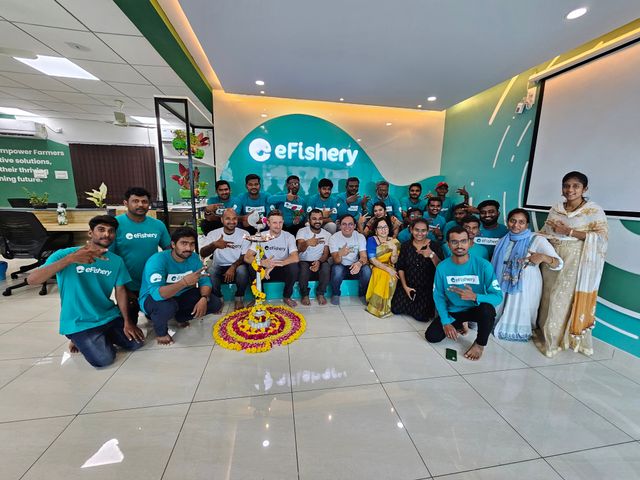
eFishery’s commercial launch in India was in March 2023 after a year-long pilot project in Kakinada, a city in the southern state of Andhra Pradesh, the country’s leading aquaculture hub.
The company operated under the legal entity eFishery Aqua Techworks Private Limited.
However, it was not under the purview of the forensic audit conducted by FTI Consulting.
eFishery’s overseas entities, including eFishery America Inc. and its non-profit foundation, Yayasan eFishery Tumbuh Bersama Budidaya, were also not covered in the audit.
DycodeX acquisition draws scrutiny
Meanwhile, one of eFishery’s past acquisitions, DycodeX, has drawn the attention of the auditors.
DycodeX, an IoT-based hardware developer founded in Bandung by Andri Yadi in 2015, aligned with eFishery’s mission to develop hardware solutions for fish farmers, which became the motivation behind the acquihire.
The transaction was initially expected to be completed in 2022, as DycodeX’s founders and team had already joined eFishery, said the source. However, the deal was finalised in 2024. The simplest approach would have been a direct share purchase from the shareholders, but former eFishery executive and co-founder Gibran Huzaifah chose a more complex method and unconventional transaction.
According to the preliminary forensic audit by FTI, the direct acquisition of DycodeX would have required an extensive audit spanning three financial years. To bypass this requirement, the deal was restructured using service agreements with four entities—CV Deeptech Solusi Indonesia, CV Teknologi Terkini Mandiri, CV Solusi Teknologi Harmoni, and CV Integrasi Teknologi Terdepan.
As part of the deal, MTN (PT Multidaya Teknologi Nusantara), an eFishery subsidiary, paid 15 billion rupiah ($920,000) to the four CVs, effectively hiring DycodeX employees under eFishery instead of formally acquiring the company.
However, personal guarantee letters were signed between Gibran and four individuals—Annisa Faza, Muhammad Alpi Gandamanah, Ramadhan Azka, and Rezki Fitrazaki—indicating that the four CVs used in the acquisition process were controlled by Gibran.
Additional documents reviewed in connection with the acquisition include a draft Conditional Sale and Purchase Agreement from October 2022, which was unsigned, and a Termination Agreement dated Dec. 29, 2023, finalising the transaction. Bank transfer records show that 5 billion rupiah was transferred to an unidentified payee in January 2024, further complicating the financial trail of the transaction.
This method raises concerns about transparency and governance, prompting FTI to audit the deal. Now Andri Yadi serves as VP of AIoT & Cultivation Intelligence at eFishery. DealStreetAsia has reached out to Yadi for comments.
Live or let go?
As reported by DealStreetAsia earlier, eFishery has a long runway given the significant capital it has raised. However, its investors are debating whether to save the company or let go.
An employee with access to eFishery’s financial statements told DealStreetAsia, under the condition of anonymity, that its current “cash and liquid assets” exceed 1 trillion rupiah ($61.3 million), while its actual revenue exceeds 3 trillion rupiah ($184 million).
According to DealStreetAsia DATA VANTAGE, the startup has raised over $314 million in equity funding, most recently in July 2023 in a $200 million Series D round led by 42XFund.
Top shareholders of eFishery
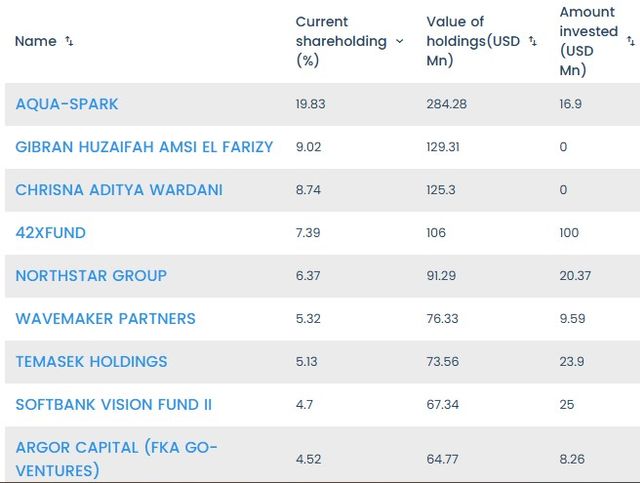
Throw in debt and it has raised close to $400 million. In comparison, its competitor Aruna has raised $70.46 million so far while Fishlog has raised $1.4 million.
YAMADA Consulting & Spire’s COO, Jeffrey Bahar, believes that eFishery has a strong chance of survival as long as its shareholders remain committed. The company’s financial restructuring, including layoffs, could improve its financial health.
“I’m quite optimistic about their survival. They have six months for restructuring and consolidation, and they’re making the necessary operational changes. Unless investors pull out, they should be okay. Investors are currently observing the restructuring and financial improvements. There will be valuation adjustments, and investors will determine a reasonable amount of capital recovery,” Bahar said.
He added that eFishery’s business model, which is similar to e-commerce and includes financing and other functions, can be sustainable. “From a business model perspective, there’s clear value creation, and the business is still needed. So, if managed properly, it can survive and sustain itself. Since there’s demand, profitability can be achieved within a reasonable timeframe. If that happens, investors are unlikely to pull out,” he explained.
Nailul Huda, director at the economic research firm at CELIOS, believes the company still has potential but requires urgent restructuring and investment.
“I hope eFishery can continue operating, but I’m pessimistic about whether it has the necessary funds,” Huda told DealStreetAsia. “The required funding is substantial, given the heavy technology used.”
Huda warned that a shutdown would impact not just employees but also the broader aquaculture ecosystem, as few digital startups have made a similar impact in fisheries. “If liquidated, the digital ecosystem would suffer. Restructuring should come first—fix internal governance, then seek investment,” he added.
However, attracting investors remains challenging. “Investor confidence is low, but if eFishery improves governance and demonstrates commitment, I hope some will recognize its role in the sector,” Huda noted.
Instead of liquidation, Huda urged transparency, efficiency, and financial discipline as key to recovery. “Fix internal issues first—transparency and governance are crucial,” he emphasised.