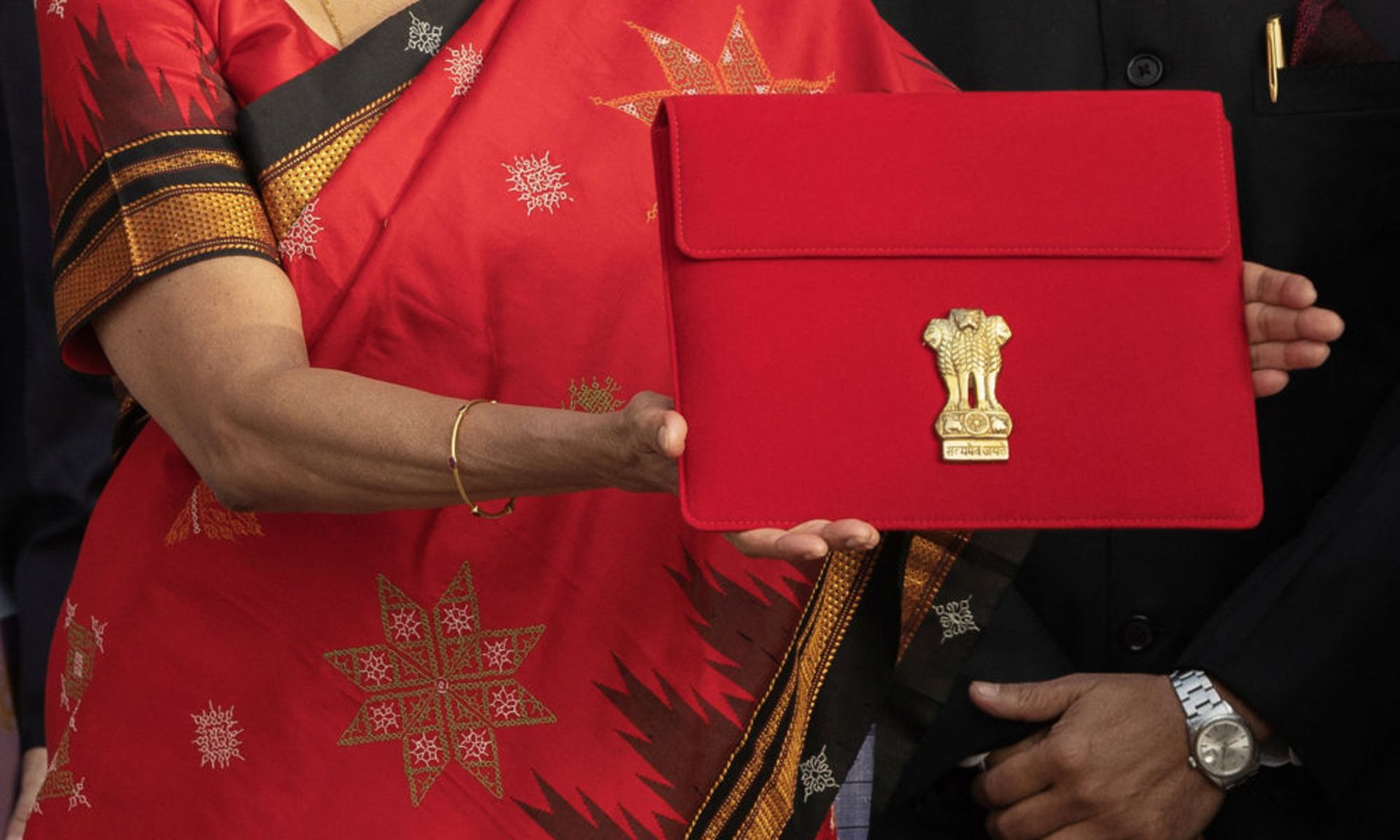
India’s Union Budget 2026-27 was dotted with slick taglines such as “transform aspiration into achievement” and “potential into performance” but lacked major headline-grabbing announcements.
Nevertheless, the annual budget document deserves to be read for what it is, not what it isn’t.
The budget, presented by finance minister Nirmala Sitharaman on Sunday, laid out massive cash aimed at driving growth in sectors crucial for India’s development amid global economic uncertainty.
“Since we assumed office 12 years ago, the country’s economic trajectory has been marked by stability, fiscal discipline, sustained growth, and moderate inflation. This is the result of conscious choices we have made even in times of uncertainty and disruptions,” said Sitharaman in her ninth consecutive budget.
At the heart of the effort to boost India’s startup and MSME ecosystem is the announcement of a Rs 10,000-crore (about $1 billion) MSME Growth Fund, designed to revive 2,000 industry clusters across the country.
In addition, the finance minister said that the Self-Reliant India (SRI) Fund, a government-backed initiative launched in 2021 under SBICAP Ventures, will receive a Rs 2,000-crore top-up in 2026-27. The fund already has a corpus of around Rs 50,000 crore and supports both fund investments and direct investments in companies.
“The measures are aimed at supporting MSMEs with the potential to scale into large units, and will meaningfully strengthen access to capital,” said Pratip Mazumdar, Partner & Co-founder of Inflexor Ventures.
“The allocations will help address liquidity bottlenecks that often stifle small enterprises… we are particularly excited by the focus on education-to-employment and the assessment of AI’s impact on jobs, which is critical for building globally competitive, future-ready companies.”
For overseas residents of India, the budget introduced notable measures, with Sitharaman proposing to raise their overall investment limit through the Portfolio Investment Scheme (PIS) in Indian equities from 10% to 24%. The expansion not only allows a larger pool of foreign capital to flow into domestic markets but also strengthens capital markets and encourages long-term investment from global investors.
Rajat Tandon, president at IVCA, called the budget “forward-looking and futuristic,” noting that it reinforces “India’s position as a safe haven for long-term investments.”
Broader push for new-gen sectors
Beyond capital infusion, the budget signals a clear sectoral push, with targeted support for multiple strategic areas, including semiconductors, data centres, AI, and biopharma.
To drive growth and capitalise on the worldwide expansion of AI and cloud services, India will offer a tax holiday until 2047 for foreign companies providing cloud services globally using Indian data centre infrastructure.
“Measures spanning sunrise sectors, including data centres, expand the opportunity landscape, particularly across infrastructure and research- and innovation-led sectors such as deep tech and defence, while also supporting employment generation across healthcare, manufacturing, sports, and tourism,” said Tandon.
In terms of the outlay, bio-pharma received a hefty Rs 10,000 crore boost, while the finance minister announced the launch of India Semiconductor Mission (ISM) 2.0 with a Rs 40,000-crore push for 2026-27.
“By significantly expanding support for domestic semiconductor equipment, materials, design, and supply-chain capabilities, ISM 2.0 will accelerate India’s journey towards self-reliance in advanced chips and position the country as a globally competitive semiconductor hub,” said Manu Iyer, General Partner and Co-founder at Bluehill.VC.
Manufacturing, which has always been a key priority of Prime Minister Narendra Modi’s vision for a self-reliant India, also received attention.
Initiatives include a scheme for mineral-rich states to establish dedicated rare earth corridors, along with three chemical parks, a container manufacturing programme, and an integrated textile sector boost.
“The Rare Earths Development Scheme, including state-led corridors and chemical parks, is structurally positive for electronics, clean energy, and defence-linked manufacturing,” said Prateek Nigudkar, Senior Fund Manager at Shriram AMC.
While these initiatives on rare earths, textiles, container and chemical manufacturing and biopharma development are framed to boost long-term growth and employment, it needs to be seen if they could position India to capture the shift away from China by the West.
All these sectors have under duress due to the policies of the Chinese government.
The government seems to be preparing the country to capture business moving out of China and use that to further drive growth in India as it aims to overtake Germany as the third-largest economy by 2030.
While the budget lays out an ambitious road map for growth and self-reliance, some experts caution that key priorities remain unaddressed.
“Despite these positives, several priorities remain unaddressed,” said Pranav Pai, Managing Partner at 3one4 Capital.
“This budget reinforces a familiar pattern in Indian policymaking: comfort in backing infrastructure for innovation, but hesitation in underwriting innovation itself,” he added, highlighting how long-term FDI incentives, ESOP and founder equity rationalisation, and safe-harbour protections for indigenous deep-tech IP creation remain conspicuously absent.
“These omissions matter, not only symbolically, but economically, because they constrain how much patient, risk-tolerant capital India can realistically attract for its next phase of innovation-led growth. We hope these gaps will be addressed through supplementary policy briefs over the coming financial year,” said Pai.