Indonesia’s markets face credibility test after leadership change, role of state capital

Indonesia’s markets face credibility test after leadership change, role of state capital

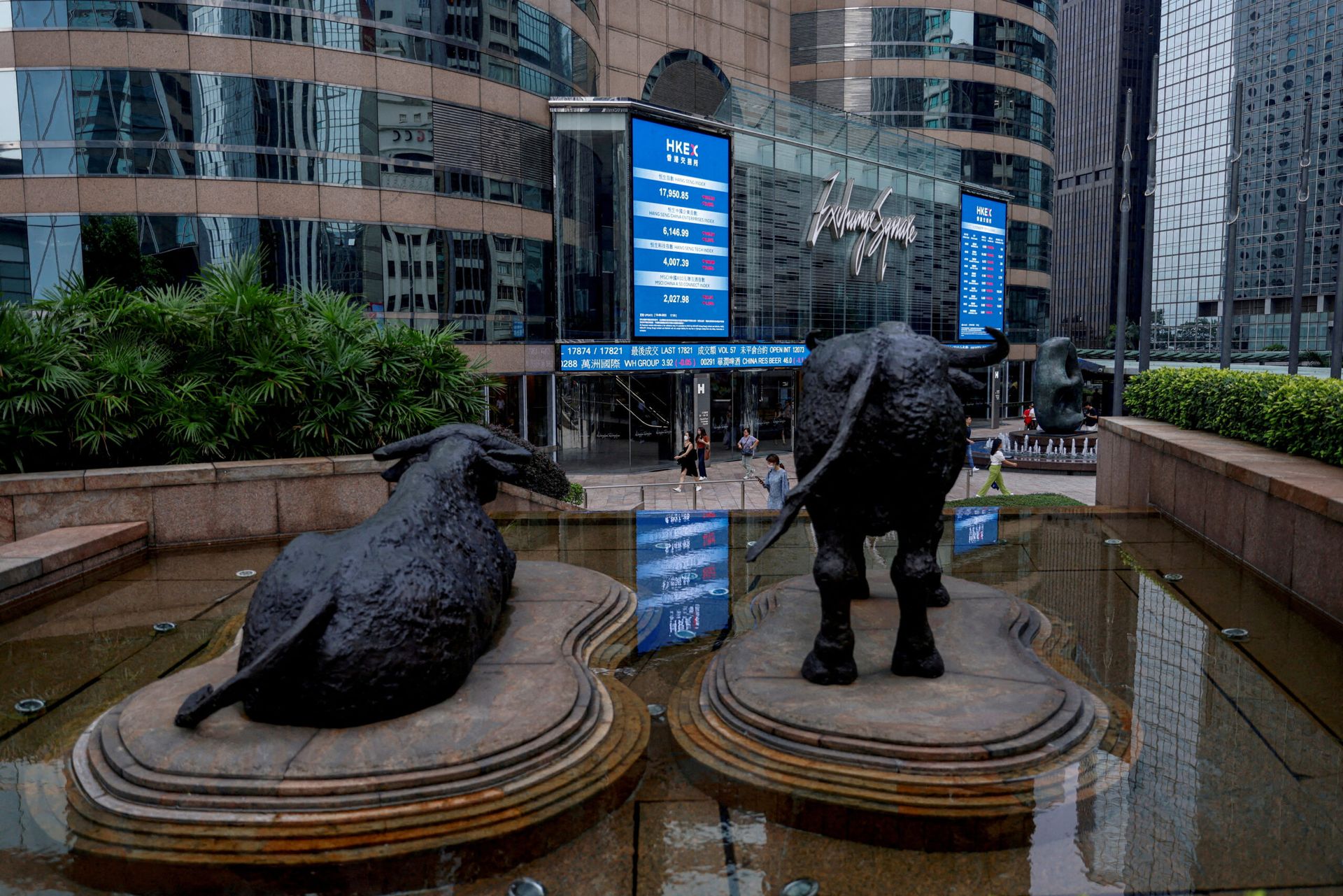
FILE PHOTO: Bull statues are placed in font of screens showing the Hang Seng stock index and stock prices outside Exchange Square, in Hong Kong, China, August 18, 2023. REUTERS/Tyrone Siu/File Photo

Indonesia’s equity market entered the first full trading week of February under heightened scrutiny, amid pressure from global index provider MSCI, heavy foreign selling, leadership transitions at key financial institutions, and the emergence of state-linked capital.

On Monday, the stock market stayed in the red throughout the session, at one point down 4.88%, closing at 7,922.73 — its weakest level since Sept 15, 2025. While each development has its own context, the overlap has amplified investor sensitivity around governance, transparency, and the direction of capital market reform.

The immediate trigger has been renewed scrutiny from MSCI, which has raised concerns over free float levels, ownership data transparency, and trading behaviour in Indonesia’s equity market.

In a recent note, Ari Jahja, equity strategist at Macquarie, wrote that “the market is still digesting the potential impact and next steps after MSCI’s warning,” noting that foreign outflows from equities reached $368 million in a single day, the largest since April 16, 2025.

MSCI’s warning has sharpened attention on long-standing structural issues, particularly the reliability of free-float data and the quality of disclosures among smaller and low-liquidity stocks. For large index constituents, the risk is mechanical rather than fundamental, as any index reclassification or adjustment could trigger forced selling by passive funds regardless of company performance.

Foreign investors appear to be responding ahead of any formal decision. Data from the Indonesia Stock Exchange show that foreign net selling in Indonesian equities reached 13.9 trillion rupiah during Jan 26–30, with major banking stocks among the most heavily sold. Analysts say the selling reflects risk reduction amid uncertainty rather than a reassessment of earnings prospects.

State response

Regulators accelerated a broad reform agenda aimed at strengthening market integrity, with an eight-point plan shared on February 1. Measures under discussion include raising the minimum free float requirement to 15%, improving disclosure of Ultimate Beneficial Ownership (UBO), enhancing the granularity of share ownership data via KSEI, and pushing forward the long-delayed demutualisation of the Indonesia Stock Exchange.

Enforcement and sanctions, particularly against market manipulation and misleading disclosures, have also been placed back on the policy agenda.

Professional groups have publicly backed the initiative. In a statement issued on Sunday, the Indonesian Analysts Association (PAEI) said the reforms were “strategic to strengthen the foundation of a more liquid, transparent, and globally competitive capital market,” while urging that implementation be “gradual, proportional, and adaptive.”

However, the reform push has been complicated by leadership transitions at both the Financial Services Authority (OJK) and the stock exchange, which have further unsettled investors. Economist Bhima Yudhistira, executive director of CELIOS, warned that the resignations at OJK had triggered a shock across the market.

“The resignation of the OJK chairman and members of the supervisory board shocked all parties,” Yudhistira told DealStreetAsia. “It appears there is pressure from the executive, particularly the President, related to major changes in the role of insurance and financial services in equity investments.”

Yudhistira cautioned that increased pressure on financial institutions to absorb equity risk could lead to governance failures. “There is a risk of Asabri version 2, where state-owned institutions are pushed into speculative stocks in the market,” he said, referring to the state-owned military and police pension fund scandal. “What Mahendra and Inarno [OJK executives] did was a direct and blunt criticism of pressure from the President.”

He added that the implications could be far-reaching. “The economy could become unstable, showing fragility and the loss of independence of financial authorities. This is a serious problem. Elite cracking is clearly happening,” he said, warning that international institutions could reassess Indonesia’s investment credibility.

For context, five executives from OJK and IDX resigned on Friday, beginning with IDX chief executive Iman Rachman, followed by OJK chairman Mahendra Siregar, capital market supervisor Inarno Djajadi, IB Aditya Jayaantara, and Mirza Adityaswara. The following day, OJK appointed Frederica Widyasari as interim commissioner, while IDX named Jeffrey Hendrik, both of whom were already serving as executives.

While concerns around governance dominate medium-term risk, market participants are also watching near-term macroeconomic signals. David Kurniawan, equity analyst at Indo Premier Sekuritas, said investors would focus on Indonesia’s full-year 2025 GDP data, typically released in early February.

“The market expects our economy to grow at around 5.1% to 5.2%,” Kurniawan said in a note. “If the official figure comes in above expectations, this could provide additional fuel for the IHSG, not just to test the 9,000 level, but to establish it as a new support floor.”

Danantara steps in

At the same time, the arrival of state-linked capital has added another layer to investor interpretation. Danantara, Indonesia’s sovereign investment arm, has said it plans to allocate around 50% of its funds to public markets in 2026, working through professional fund managers and applying strict liquidity and fundamental criteria.

Danantara chief investment officer Pandu Sjahrir said the objective is not market intervention. “The goal is to crowd in other investors while ensuring professionalism and accountability in managing funds,” he said, adding that the fund targets stocks with “very high liquidity, solid businesses, strong fundamentals, and healthy growth supported by cash flow.”

Sjahrir said Danantara had begun investing regularly since late December 2025 and would step up activity in the coming weeks, citing attractive valuations and strong economic fundamentals.

On engagement with MSCI, he said Danantara would take a constructive approach. “What has been discussed related to transparency, particularly shareholder disclosure, and free float,” he said on Monday, adding that clearer disclosures were the most immediate priority from an investor’s perspective, as cited in local media.

Danantara joined IDX and OJK to meet MSCI on Monday afternoon via Zoom call, with the SWF acting as an investor representative.

He said reforms under the Financial Sector Development and Strengthening Law (UU P2SK), including measures to allow pension funds to invest more actively, would help improve valuations over time. Raising free float levels, he added, would need to be done gradually and communicated step by step.

“We are only buyers of shares,” Sjahrir said, stressing that Danantara’s participation was based on confidence in Indonesia’s economy and attractive valuations. He also welcomed the speed of the regulatory response, calling recent actions by the exchange and regulators “very fast” and a sign of seriousness in capital market reform.

For investors, however, the optics remain sensitive. State capital entering the market as foreign funds exit has revived debate over the appropriate boundary between market development and policy intervention. Analysts say transparency and discipline in execution will be critical to maintaining credibility.

Attention is now turning to whether reforms can be implemented credibly and independently. As Macquarie’s Jahja noted, regulators are aiming to resolve key issues by March, with progress on free float and data transparency expected ahead of MSCI’s next review window.

Jahja suggests raising the minimum free float requirement to 15% from 7.5%, calling it “the most balanced policy option between liquidity enhancement and market capacity”. Bloomberg data as of November 2025 showed that 701 listed companies (73.4%) already have a free float above 15%, while 58.6% have met global benchmark standards at 20%.

Simulation data from IDX, OJK, and Macquarie Research show that raising the minimum free float to 15% could increase total free-float market capitalisation by around Rp171 trillion, including Rp102.5 trillion from 121 companies currently in the 10–15% bracket. Overall market free float would rise from 26.2% to 27.3%.

Jahja cited Bank Central Asia (BCA) as a concrete example of how index rules and liquidity constraints translate into stock-level impact. As one of the largest constituents — accounting for 22.5% of the MSCI Indonesia index — BCA illustrates how limited incremental free float can amplify market moves. Stocks with large index weights but constrained free float, he said, are particularly exposed to passive flows and MSCI-related positioning shifts.

Gita Rossiana contributed to this story.

Bring stories like this into your inbox every day.

Sign up for our newsletter - The Daily Brief
Subscribe to Newsletter


This is your last free story for the month. Register to continue reading our content