


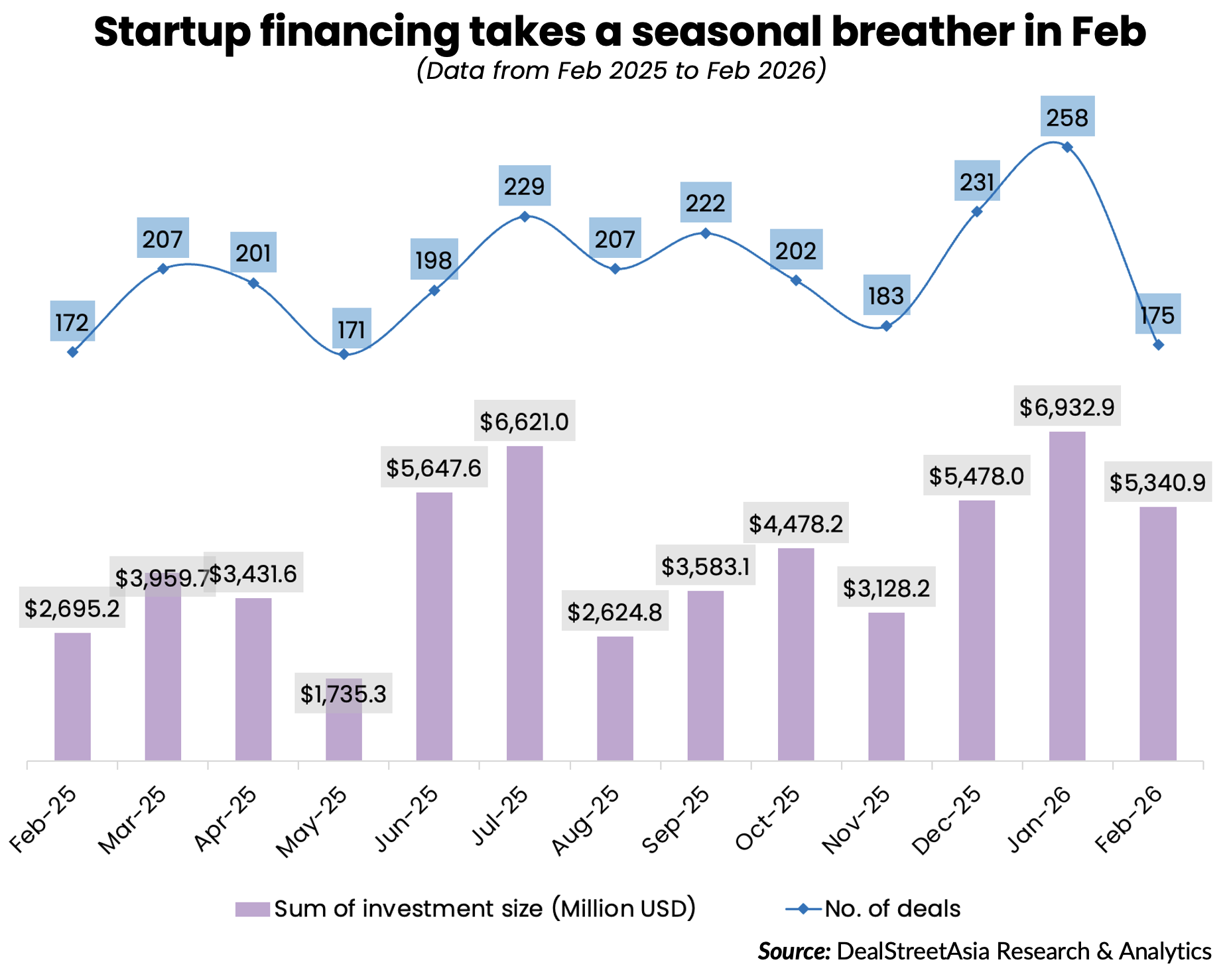
Startup financing in Greater China took a seasonal breather in February, as the week-long Chinese New Year holiday paused market activity. After a strong January, both deal value and volume slowed down last month as anticipated.
Privately-held firms headquartered in mainland China, Hong Kong, Macau, and Taiwan raised over $5.3 billion in February through the completion of 175 deals, show proprietary data compiled by DealStreetAsia.
February’s funding total was 23% less than in January 2026 while the number of deals also fell by 32.2% from the previous month.
Year-over-year (YoY) comparisons tell a different story. Compared to February 2025, when less than $2.7 billion was raised across 172 deals, last month’s funding total nearly doubled. The monthly deal volume also inched up 1.7%, indicating a sustained long-term market growth despite the holiday lull.
Megadeals remain robust
Large-ticket transactions continued to flow, with February recording 20 megadeals—defined as investments of $100 million and above—cumulatively raising over $3.6 billion.
Accounting for 67.7% of the total financing in the month, the 20 megadeals featured successful fundraisers across policy-aligned deeptech industries, including Aerospace, Semiconductor, Auto & Parts—particularly Autonomous Driving and Electrification—and Business Support Services, which exclusively includes Embodied Intelligence players.
The month booked one megadeal more than January, although the overall financing into these jumbo deals reduced by 16.2% from $4.3 billion in the prior month.
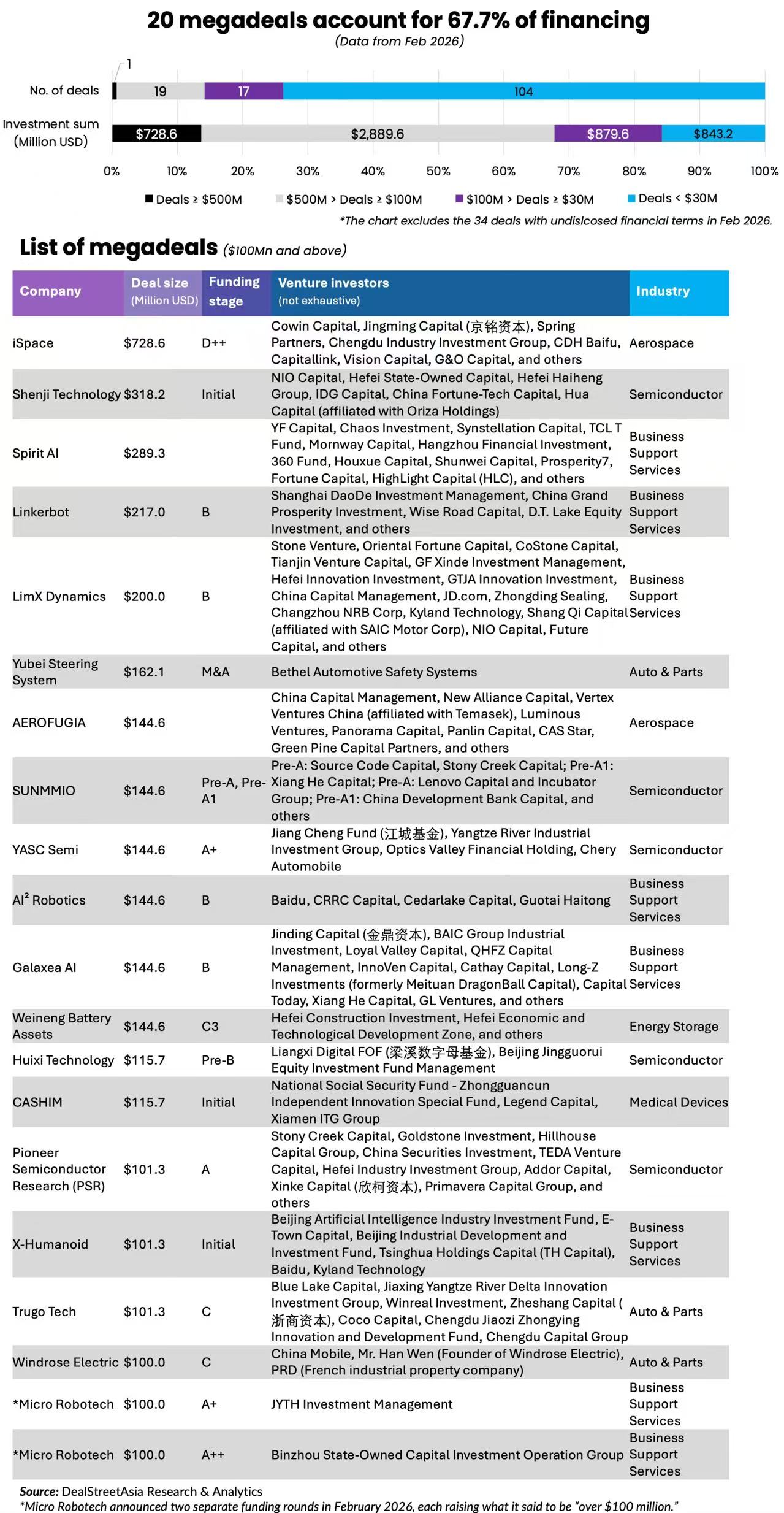
As Elon Musk’s SpaceX weighs a Nasdaq listing, its Chinese peer iSpace raised $728.6 million in a Series D++ round in February to become the month’s biggest fundraiser in Greater China. Domestic investment firms Cowin Capital and Jingming Capital jointly led the deal, which was also China’s largest financing of a private developer of commercial rockets in history.
iSpace, short for Beijing Interstellar Glory Space Technology, is also moving towards an initial public offering (IPO) on the Nasdaq-style STAR Market in mainland China, with Tianfeng Securities and CITIC Securities serving as the IPO sponsors.
Embodied Intelligence emerges as the new frontier
Following January, which saw a month of hectic dealmaking around AI software and large language models (LLMs), February’s most striking trend was an explosive growth of investments in Embodied Intelligence, such as humanoid robots, which integrate artificial intelligence (AI) into physical systems to enable interaction with the physical world, ultimately for various commercial use cases.
Now the trendiest vertical under Business Support Services, upstream and downstream Embodied Intelligence players from humanoid robot makers to “robot brain” and model developers, as well as core component (like dexterous hands) manufacturers, contributed to the bulk of financing in this industry.
Landmark Embodied Intelligence deals in February included general-purpose humanoid robot maker Spirit AI’s $289.3-million fundraising; dexterous robotic hand developer Linkerbot’s near-$217 million Series B round; and a $200-million Series B round in another humanoid robot startup LimX Dynamics.
Micro Robotech, which specialises in AI-driven quadruped robots, announced two separate funding rounds, through which it claimed to have raised “over $100 million” each. Other sizeable Embodied Intelligence deals of the month involved startups like AI² Robotics, Galaxea AI, Huixi Technology, and X-Humanoid.
This market enthusiasm for Embodied Intelligence drove Business Support Services to become the most popular industry in Greater China, with a combined $1.48 billion raised across 31 deals.
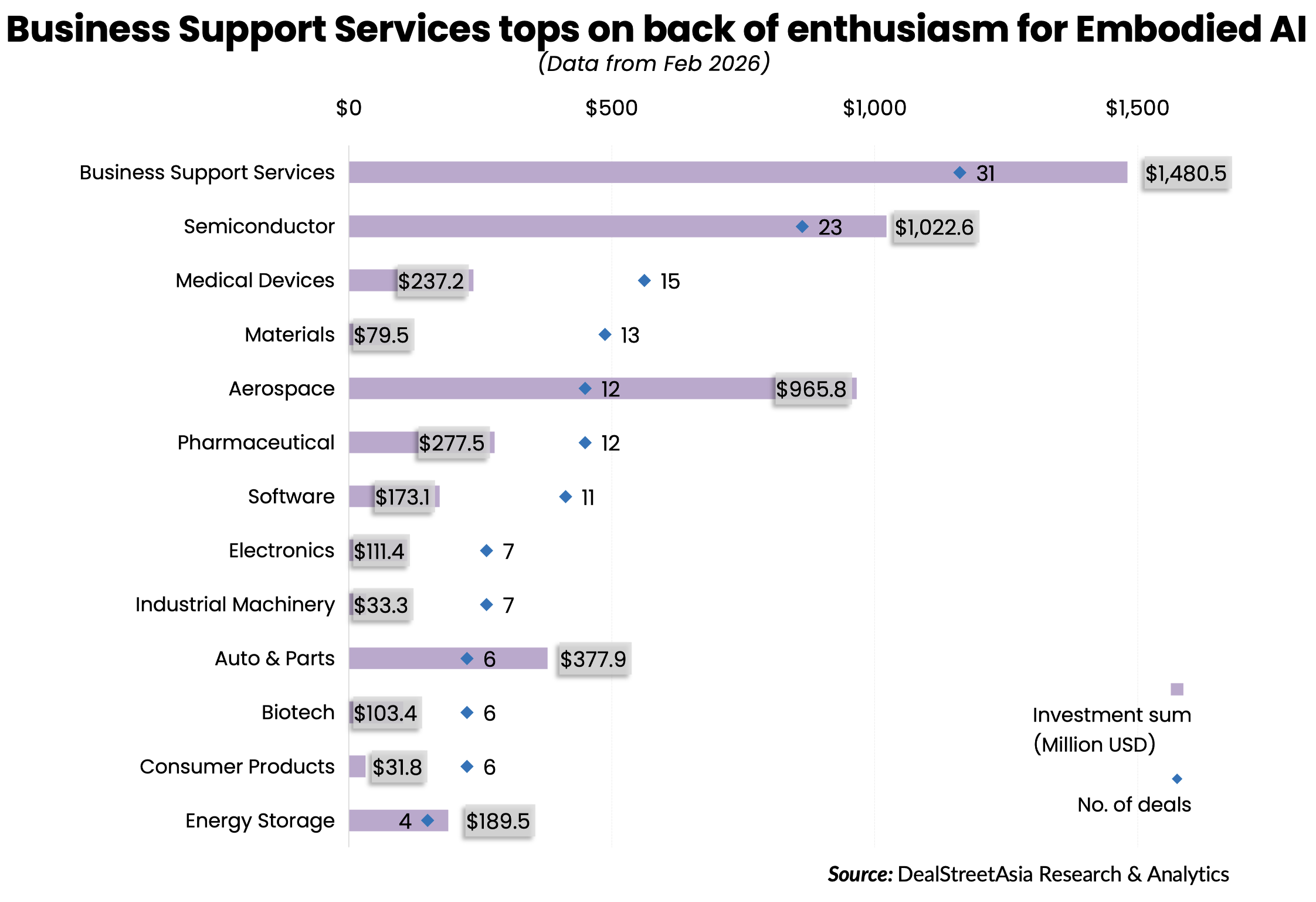
Across other industries, Semiconductor ranked second with over $1 billion raised through 23 deals, as the industry remained a primary focus for investors in Greater China amid continued government efforts to achieve chip self-sufficiency and supremacy.
Shenji Technology, a chipmaking subsidiary spun off from Chinese electric vehicle (EV) firm NIO, secured $318 million in its initial equity financing round to become the biggest Semiconductor fundraiser of the month. Valued at nearly 10 billion yuan ($1.5 billion) post-money, the startup primarily designs high-performance auto chips, as well as chips for intelligent hardware and embodied intelligence.
Legend Holdings takes the crown in investor rankings
Chinese conglomerate Legend Holdings took the crown in investor rankings in February, with its investment arms Legend Capital and tech-focused Lenovo Capital and Incubator Group participating in eight investments worth a combined $376.1 million.
CAS Star, the deeptech venture capital (VC) firm backed by the Chinese Academy of Sciences; HSG, formally HongShan Capital Group; and domestic investment firm Puhua Capital, unsurprisingly, also made it to the list of top investors given their active dealmaking in Greater China over the years.
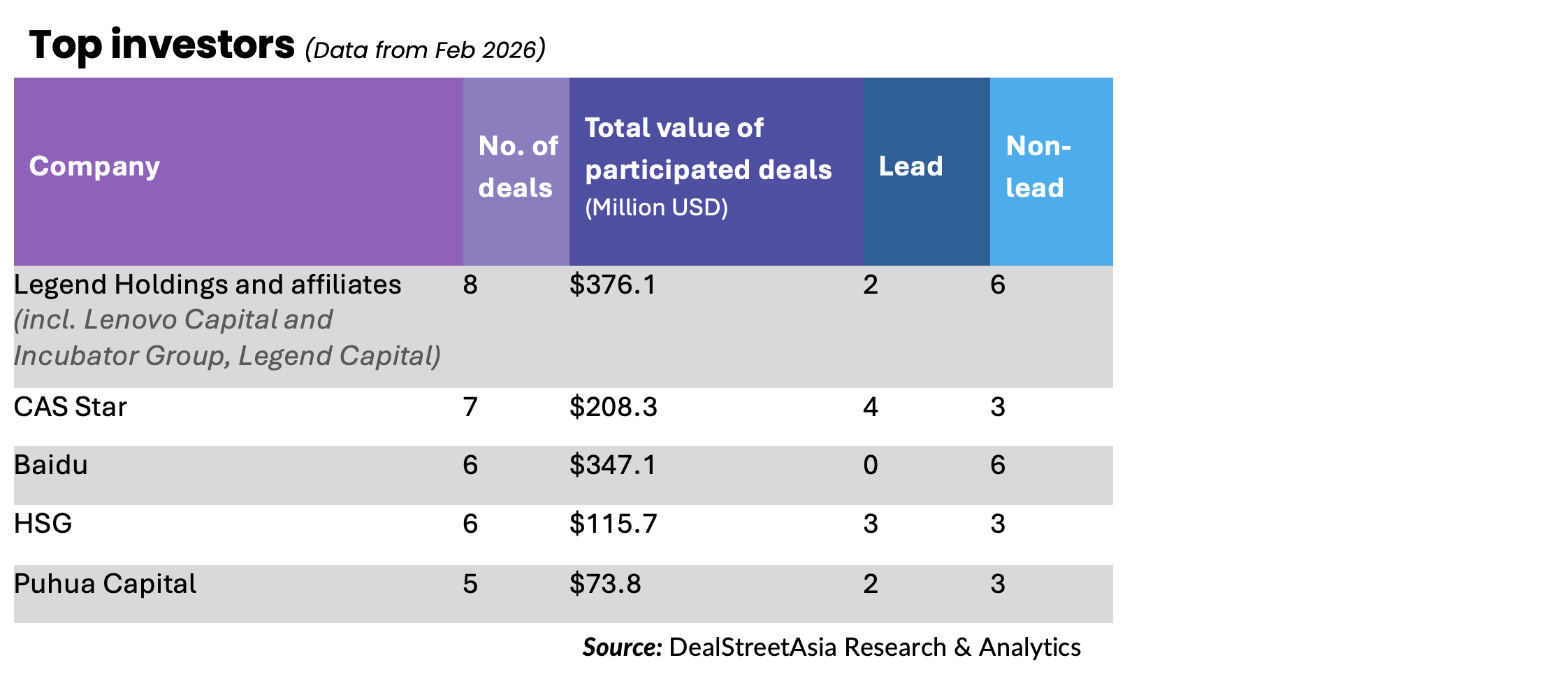
The country’s largest search engine operator Baidu, made a rare appearance this month, with participation in six deals worth $347.1 million.
Notably, five of the six Baidu-backed investments went into Embodied Intelligence startups, namely AI² Robotics, X-Humanoid, Wujie Power Technology, Maniformer, and AGILINK, marking strategic efforts by the tech giant to move AI from the digital realm into interactive applications.
Note: In our monthly analysis for February 2026, we have put together detailed charts of prominent deals, deal stages, and the most attractive sectors in the Greater China region.
Our database only considers deals officially announced by the related investee, investor(s), and/or financial advisor, while information based on market rumours and news reports citing sources is excluded.
Lynn Huang contributed to this story.


SEA Deals Barometer Report: Startup funding plunges 94% in Feb
Startup funding in Southeast Asia fell sharply in February 2026, reversing previous month’s surge driven by a single multibillion-dollar data centre investment, even as the number of deals ticked up modestly.

India Deals Barometer Report: Startup funding doubles to $2.2b in Feb on Neysa’s megadeal
Indian startup funding surged in February, driven by the billion-dollar raise of AI infrastructure startup Neysa, which accounted for half of the month’s total.