


Startup financing in Greater China hit a 15-month high in March, buoyed by a sharp recovery in both deal volume and large-ticket transactions following the Chinese New Year holiday lull.
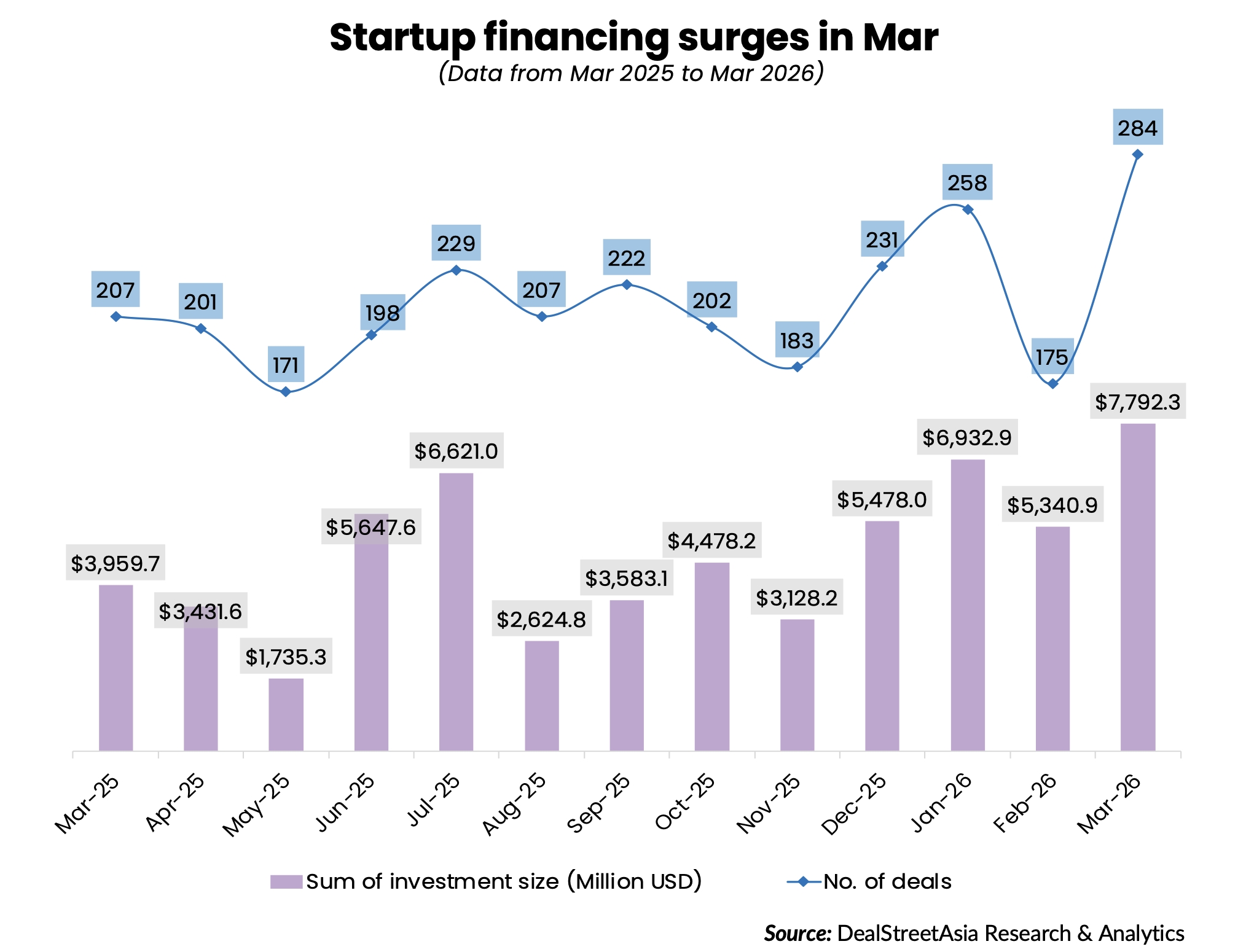
Startups headquartered in Greater China raised just under $7.8 billion in March through the completion of 284 deals, according to proprietary data compiled by DealStreetAsia.
Funding in March surged 45.9% from February’s $5.3 billion, while deal volume jumped 62.3% from 175 transactions recorded in the prior month—a sharp reversal of the seasonal slowdown typically seen in the month of the week-long Chinese New Year holiday.
On a year-on-year (YoY) basis, deal value nearly doubled from March 2025, while deal volume rose 37.2%. This strong post-holiday market rebound saw March’s deal volume reach a historical high. The month’s total financing of $7.8 billion also set a new record in 15 months.
Megadeals count grows
Large-ticket transactions remained a defining feature of dealmaking in Greater China, with March recording 22 megadeals (investments of $100 million and above) worth more than $4.6 billion.
Strong dealmaking across the board led to megadeals accounting for a smaller portion of the overall financing – at 58.1% in March, versus 67.7% in February. However, the tally of megadeals still exceeded February’s 20, with their aggregate value representing a 27.4% increase from about $3.6 billion raised across such deals in the prior month.
The 22 megadeals in March featured fundraisers from a wide range of industries, such as business support services, auto & parts, semiconductor, and biotech. A dive into their business specifics reveals a greater focus on policy-aligned verticals among deep-pocketed investors, including embodied intelligence, autonomous driving, electric/hybrid vehicles, AI-powered chipmaking, and healthtech.
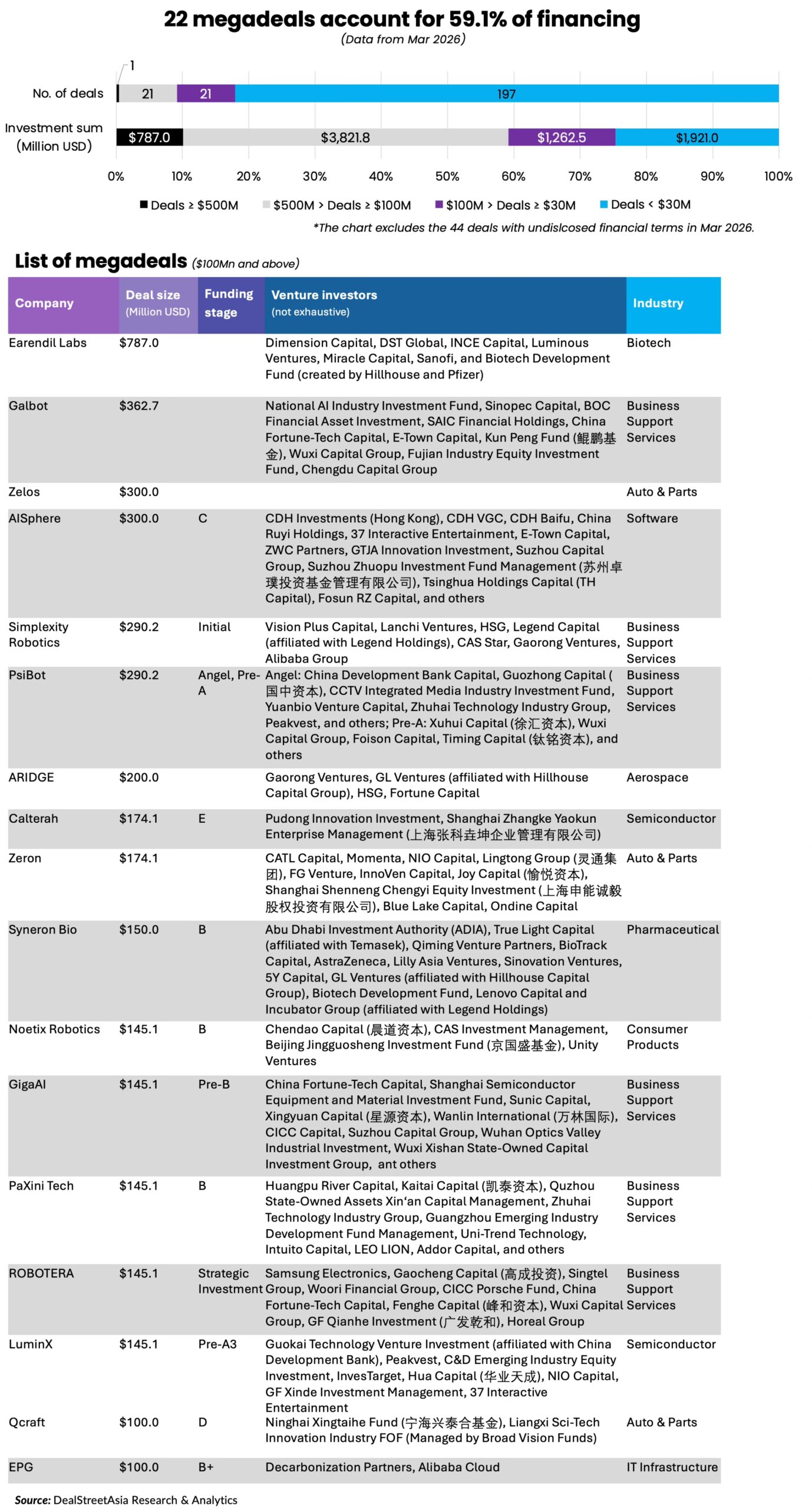
Biotech recorded just one megadeal in March, but the $787-million financing into Earendil Labs from investors like Dimension Capital, DST Global, INCE Capital, and Luminous Ventures made the startup the top fundraiser of the month. Operating in China through its affiliate Helixon Therapeutics, Earendil Labs plans to invest the new funding in advancing its AI-driven R&D platform and pipeline of first-in-class and best-in-class therapies for patients with serious diseases.
Beijing-headquartered humanoid robot developer Galbot attracted $362.7 million from a consortium of largely state-affiliated investors to become the second-biggest fundraiser of the month. Galbot claimed its position as “the highest-valued privately held humanoid robot maker in China” upon the completion of the megadeal, which came a few months after Bloomberg reported its consideration of an initial public offering (IPO) in Hong Kong this year.
With an estimated post-money valuation of over 20 billion yuan ($2.9 billion), Galbot was also one of the nine embodied intelligence startups that had raised a megadeal in March. Simplexity Robotics, PsiBot, Noetix Robotics, GigaAI, PaXini Tech, ROBOTERA, Lightwheel, and D-Robotics closed a funding round of at least $100 million, amid wide market expectations on these top players in China moving towards large-scale industrial and commercial adoption in the next few years.
Investor fervour for Embodied AI sustains
Sustained investor fervour for embodied intelligence drove business support services to retain its position as the most popular industry in Greater China.
With 32 deals raising almost $2.1 billion, the sector accounted for more than a fourth of the overall financing in March. Its dominance came on the back of a strong February, when the industry also led the charge with 31 deals raising close to $1.5 billion.
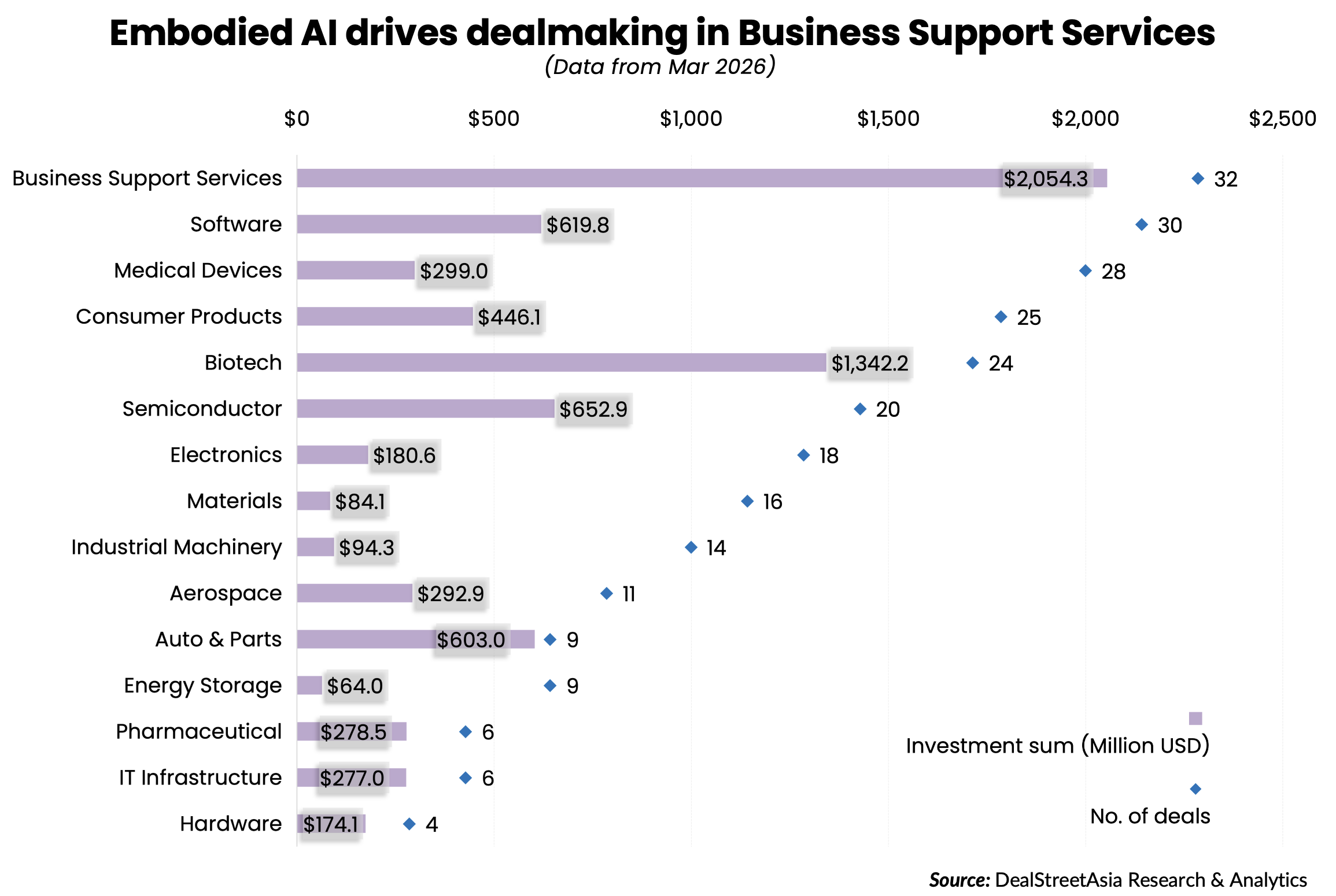
In terms of deal value, biotech rose to second with over $1.3 billion in combined financing, thanks to Earendil Labs’ blockbuster capital raise. But except for its $787-million financing, none of the remaining 23 biotech deals reached the megadeal mark of at least $100 million.
Semiconductor ranked third by deal value, with $652.9 million across 20 deals. Three of them crossed the megadeal threshold, including a $174.1-million Series E round in Calterah, which designs and develops radar chips primarily for the automotive industry. AI computing chipmaker LuminX and CIX Technology, which specialises in Arm-based intelligent computing chips, raised $145.1 million each.
Hillhouse, Oriza top investor rankings
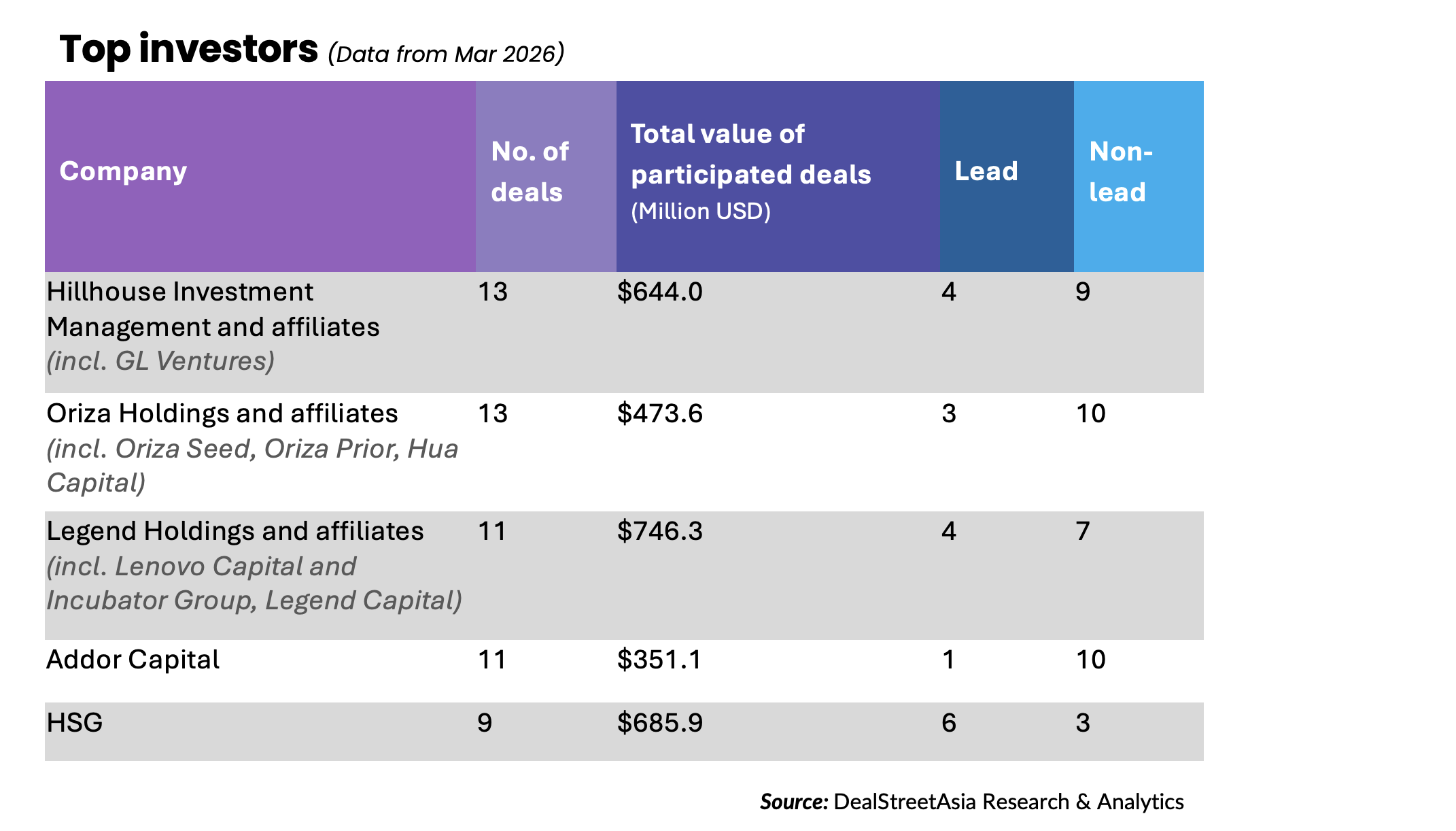
Hillhouse Investment Management, a $100-billion global alternative asset manager, and Chinese state-owned investment group Oriza Holdings were tied for first place in investor rankings in March.
The two investment groups each participated in 13 deals. Hillhouse was just a notch above Oriza Holdings, given that it served as a lead investor in four of its 13 deals and that the total value of Hillhouse-backed investments was relatively higher than that of Oriza-backed transactions.
In the month featuring a blend of top state-backed and private-capital investors, the dealmaking patterns of Hillhouse and Oriza suggest some fundamental differences between these investors of varying backgrounds.
Hillhouse bankrolled 11 of its 13 deals through its venture capital (VC) arm GL Ventures, showcasing its strong focus on early-stage dealmaking in Greater China and across mostly cutting-edge deeptech verticals like embodied intelligence and vehicle electrification.
In comparison, Oriza-backed deals were also mostly early-stage but also spanning venture- and growth-segments across both tech-centric and traditional hardware and industrial machinery.
More prominently, Hillhouse favoured dealmaking in US dollars, with more than half of its deals in March being USD-denominated, versus Oriza, which announced only one USD investment.
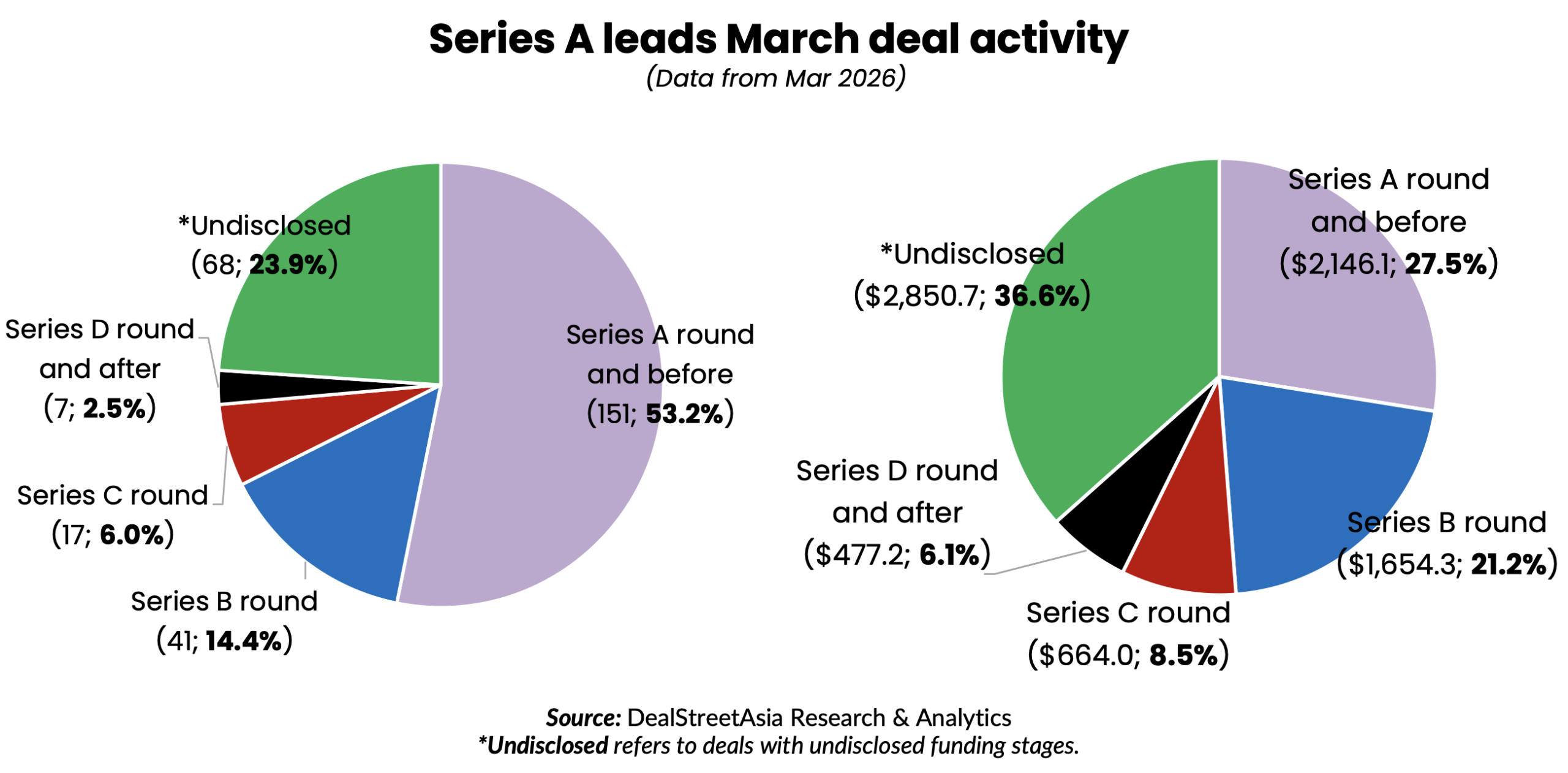
Note: In our monthly analysis for March 2026, we have put together detailed charts of prominent deals, deal stages, and the most attractive sectors in the Greater China region.
Our database only considers deals officially announced by the related investee, investor(s), and/or financial advisor, while information based on market rumours and news reports citing sources is excluded.
Lynn Huang contributed to this story.



SEA Deals Barometer Report: Funding surges in March as megadeals return
Startup funding in Southeast Asia rebounded sharply in March, with total capital raised reaching $582.2 million across 44 equity deals, according to data compiled by DealStreetAsia, marking a strong recovery after a subdued start to the year.

India Deals Barometer Report: Startup funding slips to $1.47b in March following Feb surge
After a sharp, single-deal-driven spike in February, venture capital and private equity investments into Indian startups cooled in March.