Making a good start into the new year, Indian startups raised over $4.43 billion in January 2022 across 199 private equity (PE) and venture capital (VC) transactions, according to proprietary data compiled by DealStreetAsia. This is more than a four-fold increase from January last year when COVID-hit startups raised mere $1 billion across 89 transactions.
However, when compared to the preceding month of December, transactions witnessed a marginal dip both in terms of volume and value last month.
In December 2021, startups raised as much as $4.86 billion across 201 transactions.
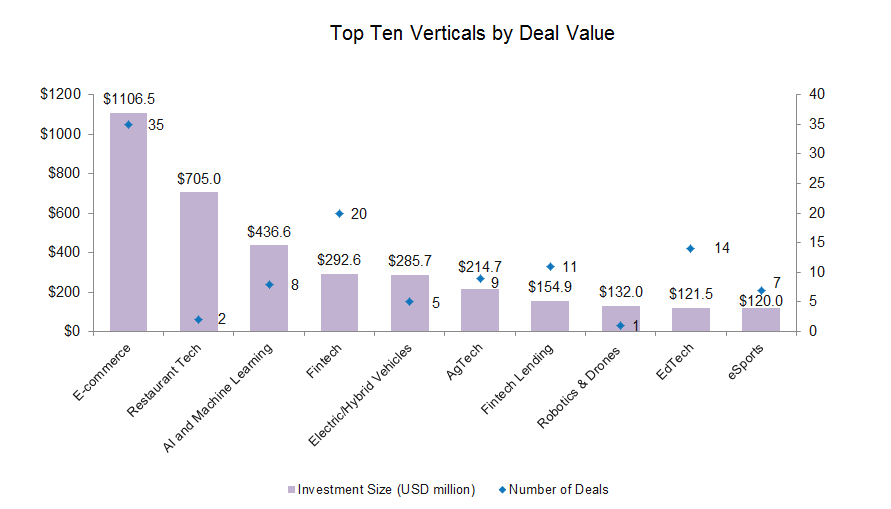
According to experts tracking the sector, the fundraising activity in the startup ecosystem is expected to continue with sectors such as fintech, SaaS, D2C, B2B, logistics and education increasingly gaining traction.
Out of the total transactions in January, the value of 26 deals was not disclosed.
India saw four startups enter the unicorn club (startups valued at $1 billion and above) in January. These include names such as social commerce startup DealShare, end-to-end enterprise HR software DarwinBox, edtech startup LEAD, and artificial intelligence startup Fractal – all from different sectors even as technology happens to be the common thread.
In the whole of 2021, as many as 43 startups in India made it to the unicorn list while the total number of startups valued at over $1 billion so far stands at 85. Going forward, the country may add another 45 startup unicorns in the next 12-18 months, according to a report released by PGA Labs last month.
The country clocked at least 11 mega transactions – those amounting to over $100 million (mega deals), totaling $2.6 billion. They comprised 58% of the total deal value in January. In comparison, fundraising growth in December was fuelled by 14 mega deals that were worth $3.3 billion.
To break down the numbers further, Bengaluru-based food ordering and grocery platform Swiggy raised the largest round of $700 million in a bid to give a push to its core platform and newly launched quick grocery delivery service Instamart.
The round was led by asset manager Invesco, and also saw participation of a host of new investors such as Baron Capital Group, Sumeru Venture, IIFL AMC Late Stage Tech Fund, Kotak, Axis Growth Avenues AIF- I. Swiggy was reportedly valued at $10.7 billion in the round.
Logistics, financial services among top grossers
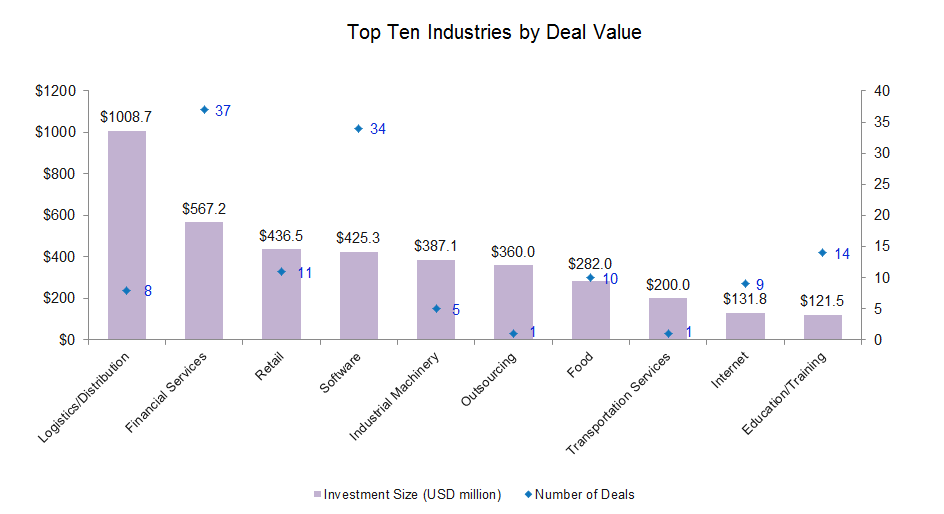
Fundraising by Swiggy helped push logistics and distribution industry to the top as startups within the industry raked in $1 billion across eight transactions.
Swiggy has earmarked heavy investments into Instamart amid growing competition in 10-minute grocery delivery space from the likes of Grofers (now Blinkit), BigBasket and Zepto.
Mukesh Ambani-led Reliance Retail’s $240-million investment in hyperlocal delivery startup Dunzo was another big deal in the logistics space. Post the investment, Reliance Retail has become the largest shareholder in Bengaluru-based Dunzo with 25.8% stake.
Explaining the rationale behind investing in Dunzo, Reliance Retail said in a statement that Dunzo will enable hyperlocal logistics for the retail stores operated by the company, further adding onto its omni-channel capabilities. It added that Dunzo will also facilitate last mile deliveries for JioMart’s merchant network.
Financial services, led by financial technology, was the second most funded industry with a total of $567 million in its kitty. The capital was raised across 37 transactions. Novo, a neo-bank focused on small businesses, raised the largest round of $90 million in its Series B round led by Stripes. Novo was valued at $700 million in the last round.
Other startups within financial services that secured funding in January include Refyne, M2P Fintech, DMI finance, Rupeek, Stockgro, Vyapar Rupifi, Pine Labs, CASHe, Innoviti Payment, among others.
Retail occupied the third spot with $436 million funding across 11 deals, led by Udaan’s $250-million financing round via convertible note and debt. DealShare’s $130-million financing was another big deal during the month, which saw participation from Tiger Global, Alpha Wave, and Kora Investment.
Together, the top three industries – logistics/distribution, financial services, and retail – garnered $2 billion, accounting for about 45% of the total value.
Early-stage vs growth capital
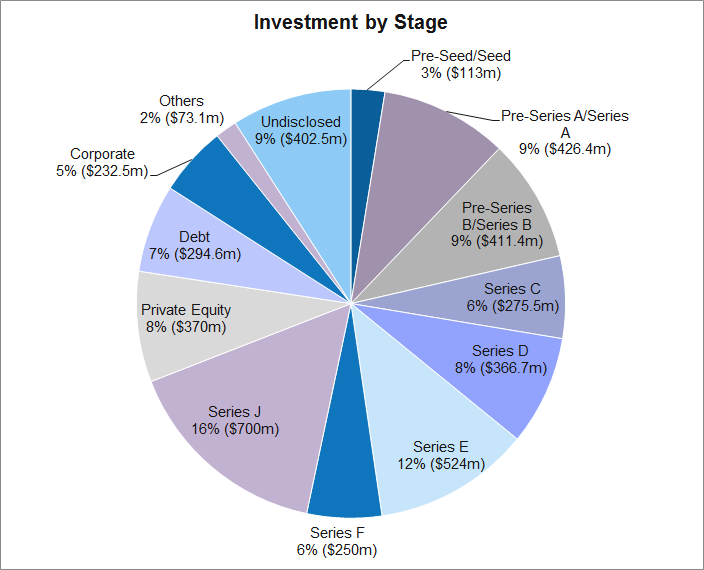
The value of pre-seed and seed deals increased 36% to $113 million in January across 71 transactions from $82.7 in December across 75 transactions. EVage, an Indian all-electric light commercial vehicle OEM, raised the largest seed round of $28 million, followed by crypto investment app Flint ($5.1 million) and The ePlane Company ($5 million).
Meanwhile, startups in pre-Series A and Series A stages mopped up $426.4 million through 51 transactions compared to $240.4 million across 45 transactions in December. Some of the large Series A rounds in January were that of social investment startup StockGro ($32 million), digital payments startup Rupifi ($25 million), game streaming and e-sports platform Rooter ($25 million), and dentalcare startup Smiles.ai ($23 million)
Growth-stage deals accounted for bulk deal value. Companies in Series B or post-Series B rounds collected an aggregate of $2.5 billion across 29 transactions in January as against $3.72 billion across 40 transactions in December.
There were about 13 debt deals worth $294.6 million, while two PE deals worth $370 million were closed in January. Corporate deals, too, picked up in the month and were worth $232.5 million.
Most active investors
Early-stage venture firm Better Capital, which is run by Silicon Valley entrepreneur Vaibhav Domkundwar, emerged as the most active investor in January with 14 investments. The firm led funding rounds for fintech startup IppoPay, crypto platform Sahicoin, creator-owned marketplace startup HYPD, AI-powered customer data and marketing platform for e-commerce and D2C brands Contlo, and OTT platform STAGE.
Last November, Better Capital raised its maiden fund of $15.2 million to invest in 40-50 sector agnostic pre-seed and seed-stage startups with a median check size being $300,000. The fund is backed by founders, operators and investors from across the world, including Meta, Google, Uber, LinkedIn, Tiger Global, TPG, The World Bank among others.
Venture Catalysts, along with its accelerator fund 9Unicorns, was the second most active investor with at least 12 deals in its kitty. They led funding rounds for cross border healthtech platform Hospals, invoice factoring startup Reevoy, vernacular storytelling platform Ekank Technologies, dietary supplement brand Power Gummies, and pitching startup Easy to Pitch.
Sequoia Capital India, along with its startup accelerator programme Surge, made 10 investments while Blume Ventures made seven investments. Meanwhile, Tiger Global, Alpha Wave Incubation (AWI), and Inflection Point Ventures made six investments each.
‘In an era of virtual dealmaking, stakeholders tend to be more transparent’ – DFIN’s Peter McMillan
Over half the deals in the next 3 months will be hosted virtually according to 79% of the respondents in DFIN’s DealMaker Meter Survey. Peter McMillan, Head of Sales for APAC at DCIN speaks of the advantages of virtual dealmaking as well as the pitfalls to be avoided, in an exclusive interview with DealStreetAsia
Startups garnered just over $1.7 billion in January across 126 venture capital and private equity deals...
Read the Report
The Deals Barometer is brought to you by
We use cookies to help us better understand your experience of our site. The information we collect is used to measure and improve performance, and to better understand your needs. We may share this data with our hosting, advertising and analytics partners. Cookie Policy
This website uses cookies to improve your experience while you navigate through the website. Out of these, the cookies that are categorized as necessary are stored on your browser as they are essential for the working of basic functionalities of the website. We also use third-party cookies that help us analyze and understand how you use this website. These cookies will be stored in your browser only with your consent. You also have the option to opt-out of these cookies. But opting out of some of these cookies may affect your browsing experience.
Necessary cookies are absolutely essential for the website to function properly. These cookies ensure basic functionalities and security features of the website, anonymously.
Cookie
Duration
Description
cookielawinfo-checkbox-analytics
11 months
This cookie is set by GDPR Cookie Consent plugin. The cookie is used to store the user consent for the cookies in the category "Analytics".
cookielawinfo-checkbox-functional
11 months
The cookie is set by GDPR cookie consent to record the user consent for the cookies in the category "Functional".
cookielawinfo-checkbox-necessary
11 months
This cookie is set by GDPR Cookie Consent plugin. The cookies is used to store the user consent for the cookies in the category "Necessary".
cookielawinfo-checkbox-others
11 months
This cookie is set by GDPR Cookie Consent plugin. The cookie is used to store the user consent for the cookies in the category "Other.
cookielawinfo-checkbox-performance
11 months
This cookie is set by GDPR Cookie Consent plugin. The cookie is used to store the user consent for the cookies in the category "Performance".
viewed_cookie_policy
11 months
The cookie is set by the GDPR Cookie Consent plugin and is used to store whether or not user has consented to the use of cookies. It does not store any personal data.
Functional cookies help to perform certain functionalities like sharing the content of the website on social media platforms, collect feedbacks, and other third-party features.
Performance cookies are used to understand and analyze the key performance indexes of the website which helps in delivering a better user experience for the visitors.
Analytical cookies are used to understand how visitors interact with the website. These cookies help provide information on metrics the number of visitors, bounce rate, traffic source, etc.
Advertisement cookies are used to provide visitors with relevant ads and marketing campaigns. These cookies track visitors across websites and collect information to provide customized ads.