Partner content in association with
From automation to augmentation: How AI can become a superpower for accountants in APAC

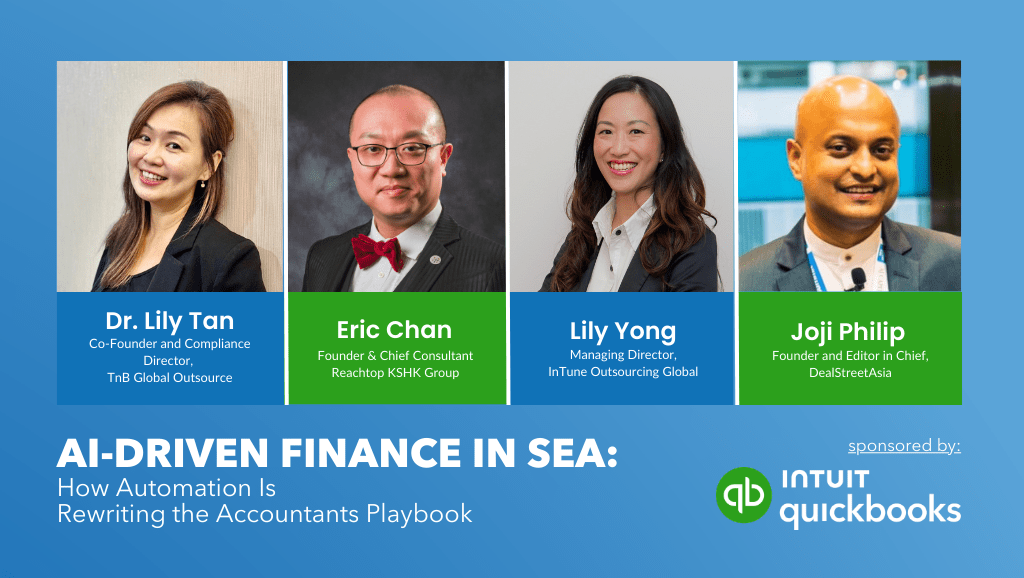
A recent webinar sponsored by Intuit Quickbooks provided a blueprint for accountants to deploy AI and move up the value chain within their organisations
The accounting industry offers a contrast to the often gloomy evaluations about the disruptive potential of artificial intelligence and automation. Even amid concerns surrounding redundancies, more forward looking practitioners view AI as an opportunity to offload some of the arduous aspects of their jobs. They believe this will give them the time and bandwidth to stake a claim as true partners and profit centres within their organisations.
At a recent webinar sponsored by Intuit Quickbooks in partnership with DealStreetAsia, a panel of industry experts discussed the progress of AI within the accounting practice, workarounds to address its shortfalls, and areas where it could add value. Rather than be focused on buzzwords and jargon, the session was grounded in real cases. The panellists included Lily Yong, MD, InTune Outsourcing Global; Dr Lily Tan, co-founder and compliance director, TnB Global Outsource Pte Ltd and Eric Chan, founder and chief consultant Reachtop KSHK Group, in a session moderated by Joji Thomas Philip, editor in chief at DealStreetAsia.
Some of the key takeaways from the discussion were:
AI will move from being a single tool to a suite of digital specialist functions: AI in accounting is evolving from individual apps to a network of AI agents which form a cohesive interconnected system. KSHK Group’s Eric Chan observed, “AI agents do not just see numbers but patterns, relationships, and opportunities with a 360° view. Purpose-built AI assistants are designed to handle specific time consuming tasks across business operations.” Giving an example of the various sorts of agents, Chan pointed to the customer agent which is focused on growth and responsiveness. The project management agent helps get new assignments underway, detailing scope of work, budgets, and timelines; and finally, the finance agent serves as an on-demand analyst with insights into P&L, cash flow and balance sheets. Suites like Quickbooks from Intuit help give an accountant a comprehensive view and manage everything from leads to customer loyalty. Chan said, “This is not just automation but augmentation. It gives you superpowers to work smarter, make better decisions and confidently grow your business.”
Many of the existing bottlenecks within accounting are being addressed by AI: Among the biggest bottlenecks facing accountants are chasing after documents and sales collection realisation: the latter made exponentially more complicated by the multiplicity of payment mechanisms. InTune’s Lily Young hoped to see AI play a pivotal role in the time consuming process of chasing after documents, with automated reminders and status checks.
AI is already delivering on its promise of value and savings: With enhanced ability to recognise patterns, AI helps identify the most profitable sliver within a P&L or raise awareness of a threat or a problem. Chan cited the instance where analysing AI expenses resulted in a monthly saving of $2,000, after it was discovered that a client was still paying a subscription fee for services that they no longer used.
Even as AI advances, human oversight remains non-negotiable: Since AI tends to hallucinate or lie under certain conditions, there is no substitute for humans taking the lead, setting frameworks, and weighing in on critical decisions. TnB Global’s Lily Tan recommended an attitude of professional scepticism and said, “When technology is deployed for processing and pattern detection, it will work much better than humans. However, automation must be continually reviewed and not operate as ‘set and forget’. It becomes dangerous if accountants can use these tools but not explain the numbers, particularly when it comes to audits, investigations, and regulator queries.” Tan believed auditors must not just embrace technology but, given the different frameworks within jurisdictions, keep abreast of the latest regulatory changes. “Automation can flag items, but it needs a manual override option,” she said.
Read on for a transcript of the webinar, edited for clarity and brevity.
What are the most common bottlenecks that you encounter repeatedly?
Lily Yong (LY): Chasing after documents is very time consuming and requires multiple reminders. The second most time consuming task is reconciliation across multiple areas: banks, suppliers, and sales. The biggest bottleneck is sales collection reconciliation because of multiple modes and payment channels including credit cards and e-wallets. It takes a lot of time to track what is being received versus what is being recorded as sales and accounting for aspects such as adjusting credit card charges to the tally. I’m really looking forward to automation or AI that can reduce the time spent on this work.
From a practice and compliance lens, when you consider a typical SME in Singapore or Southeast Asia, what does a messy month-end look like? What are the processes that cause 80% of the mess?
Dr LILY TAN (LT): In Singapore, many SMEs have already adapted technology such as cloud accounting systems. While 100% of clients are yet to adopt technology, the time taken for following up with customers has reduced quite drastically. Right now, the (biggest problem is) shortage of manpower. Clients that I worked with for over 20 years have accountants who have been with the firm for a long time and are unwilling to change. However, AI is not the future — it is already here. If you don’t change your mindset, the world will change without you.
When we look at AI and automation, how do we separate the real from the hype?
LY: We are looking at how our new digital teammates are working and helping us out. At this juncture, it is still very preliminary and exploratory. But it is here to stay. My advice is to embrace it.
How do you draw the line between useful and risky automation?
LT: Automation does not mean AI. It is yet to mature. Speaking specifically about a regulated, audit sensitive environment, large volumes of data can be processed by automation. It can help in cases such as snap receipts, and the import of the sales data from the CSV. Automation can assist us, but it does not replace professional responsibility.
When we mention data extractions like the OCR and reconciliations, we must set a rule base, and it must be standardised. We must perform validations and check whether there are any missing sales. We can set the rules: for instance, whenever you see FedEx, there will be delivery charges. The audit trail is very important because due to automation, the accountant is unaware of what has already been posted.
A new term I have learnt is professional scepticism. As accountants, regulators will penalise us (for discrepancies) when we finalise accounts, and we cannot say ‘AI did the accounts for me, and this is automation.’
What’s the simplest way to explain AI as an assistant to accountants worried about job security?
EC: Bookkeeping is a very important task, but not many business owners realise that. They are more focused on sales and generating income. Accountants in the past and even today are considered a cost to the company. While this cannot be changed overnight, it is our responsibility to educate clients and customers. We are not a cost centre but can be a profit centre. We have a background in finance, are sensitive to numbers, and possess professional scepticism. We can help them to analyse financial data and transform ourselves from a bookkeeper to an accountant to a business advisor. We can make recommendations on preparing for challenges and trends within financial statements.
If I were an accountant, what should I automate first, without breaking things?
LT: There isn’t any software that will meet all your needs. To improve workflow, understand the current requirements of your clients. Our accounts receivable (AR) department is core and the first that needs to be automated. In Southeast Asia, many customers still use manual invoicing. Before COVID, I too would stick to the desktop and preferred working on it. We changed to cloud just before the pandemic and I soon discovered how simple it was. It helps change the workflow without doing anything: one does not have to write or use excel. The difference between the desktop and cloud system is when you issue an invoice, sending it to the client is just a button away, and it then gets tracked by the system. The customer can no longer make excuses about not having received an invoice.
From head to toe, everything can be automated. As accountants, we have more time for informed conversations with company leaders on which product is more profitable and why. That will help us move from being a call centre to a profit centre.
When you look at outsourcing models, what is the biggest gamechanger?
LY: The cloud solution was a game changer. My firm and clients adopted cloud in 2016. Through Covid, we were able to take laptops home, set up workstations and it was business as usual.
For an outsourcing model, the software feature that is really a game changer is the bank fee. Previously we dealt with bank statements by getting a hard copy and the accounting team had to key them in manually, line by line. It was a tedious process that was subject to errors. With the bank fee, once a payment is executed in a bank, or received, it gets linked to the software and goes live. From a very long time span to almost live, business owners can see their cash move in and out of the accounting system and no longer need to log into the bank to get this information.
Moving forward, the Intuit agents that are going to be launched include the customer agent, the project management agent, and an auto chaser for missing documents. Given my team currently spends a lot of time reminding clients of missing aspects, the auto chaser would be something that I would love to see happening sooner than later.
If you were to walk into a firm that is still Excel heavy, what’s your minimum viable automation playbook?
EC: My recommendation would be to do the expenses first, because it is one of the most tedious processes in bookkeeping if they are still using Excel. Excel is not an accounting software and only a spreadsheet. Everything needs a manual input and is error prone.
If the data is corrupt, the financial reports will also be corrupted. For a company that would like to switch to the AI era, do not change everything at once. Take baby steps and after you notice the benefits, take another step.
What are the non-negotiables when it comes to audits adopting AI driven workflows?
LT: Technology brings PSP: processing, speed, and pattern detection. Sometimes the mistakes are due to human error. For instance: someone keying in $1,000 could accidentally type in $100,000. When technology is deployed for processing and pattern detection, it will work much better than humans.
However, while there are millions of tools out there, they cannot explain numbers. It’s dangerous if accountants can only operate these tools but not explain, particularly when it comes to audits, investigations, and regulator queries.
Automation must be continually reviewed and not operate as ‘set and forget’.
There are also regulatory changes that take place in taxes and rulings that are a red flag. Accountants and auditors need to not just embrace technology but also keep abreast of the latest regulatory changes. Automation can flag items but needs a manual override option.
How do you balance cost and compliance in the Southeast Asian market especially when SMEs are price sensitive but still need proper controls?
LY: It’s hard to balance. But when you choose to do business, you must accept everything that comes with it. Accountants can take care of the compliance cost which becomes a very small proportion of a huge business. In Malaysia, compliance has been increasing over the last couple of years because the government runs a digitised model.
What’s your advice for teams that skip process discipline but then blame the tools when things go wrong?
EC: It’s human instinct to blame others, but accountants are trained to be responsible. We need to change our mindset. Whether you’re in Malaysia, Singapore or Hong Kong, different governments have their own norms. As an accountant, we need to be aware of how we can dig out the treasure from financial statements. Pattern recognition sometimes makes us aware of a threat or a problem.
To give you a real life example, one of our clients wanted to know how they had no cash despite healthy inflows every month, and why they needed extra funds to pay salaries and rent.
I used AI to analyse expenses and discovered that the CEO subscribes to multiple different apps. He was paying $5,000 per month on subscriptions! I listed these, and it turned out he didn’t use half of them anymore but was still paying.
How do accountants earn more by doing less manual work? If AI frees up their time, what can they do which is more lucrative?
LY: An ex-client just returned to the firm last week. They had previously moved to a smaller accounting freelance firm to save costs. When asked why he said, “Because I know you can do it. I have started businesses in Singapore and Dubai, and previously it was just Malaysia. I don’t think the current firm can cope.” My message is, if we can provide business strategy advice, cross border clients will pay for it because they lack the technical expertise.
Secondly, I’m able to advise clients on business profitability. The third reason is tax advice from accountants.
LT: We must change our mindsets from being traditional manual accountants to be an advisor. I had a client who was sceptical about onboarding a cloud system. They have 100 odd employees, and the change was not easy. He messaged last week to say his cash flow has increased by at least 15%. It’s because his firm can issue invoices faster, review reports and set reminders for payments.
If an accountant were to move into an advisor role in the next six to 12 months, what’s the simplest way to get started?
EC: Many candidates may be afraid of this change. Nothing teaches us about how to be an advisor. To make the transition, think of yourself as your own client. Reveal your own profit loss and make use of the technology to help yourself improve. Give yourself advice on how to do better. Through AI, analyse your profit/loss and financial statements. Once you do it and experience benefits, you have the confidence to tell your clients about your experience and help them do the same.
Finance agent style summaries can be useful, but how do you ensure that the narrative doesn’t obscure underlying accounting issues?
LY: It’s all about my mindset. When I work with an AI agent, I regard it as a teammate or staff. When I check the work of my actual staff, why not check what the digital staff is doing? The AI agent is meant to ease our work; not take it away completely.
As an accountant, I can see the narrative being generate by AI and whether the numbers make sense. I compare it to what I know about the client and spend time reviewing it.
EC: AI agents are our staff, and we need to learn how to communicate. Many of you have already heard about the importance of AI prompts. We must learn how to ask questions. With the right prompt and trial and error with different AI, we can use these agents in a much better way.
If the AI agents’ output are in English only for now, how should teams handle bilingual source documents and local language notes without creating errors?
LT: There are so many software that can convert and translate. We need to have the company SOP, procedures and policies. AI is really automation.
Missed a session or want to rewatch? You can access the full webinar recording and key takeaways here: