Partner content in association with
Global-from-day-one: How deep tech partners with DBS to drive international growth

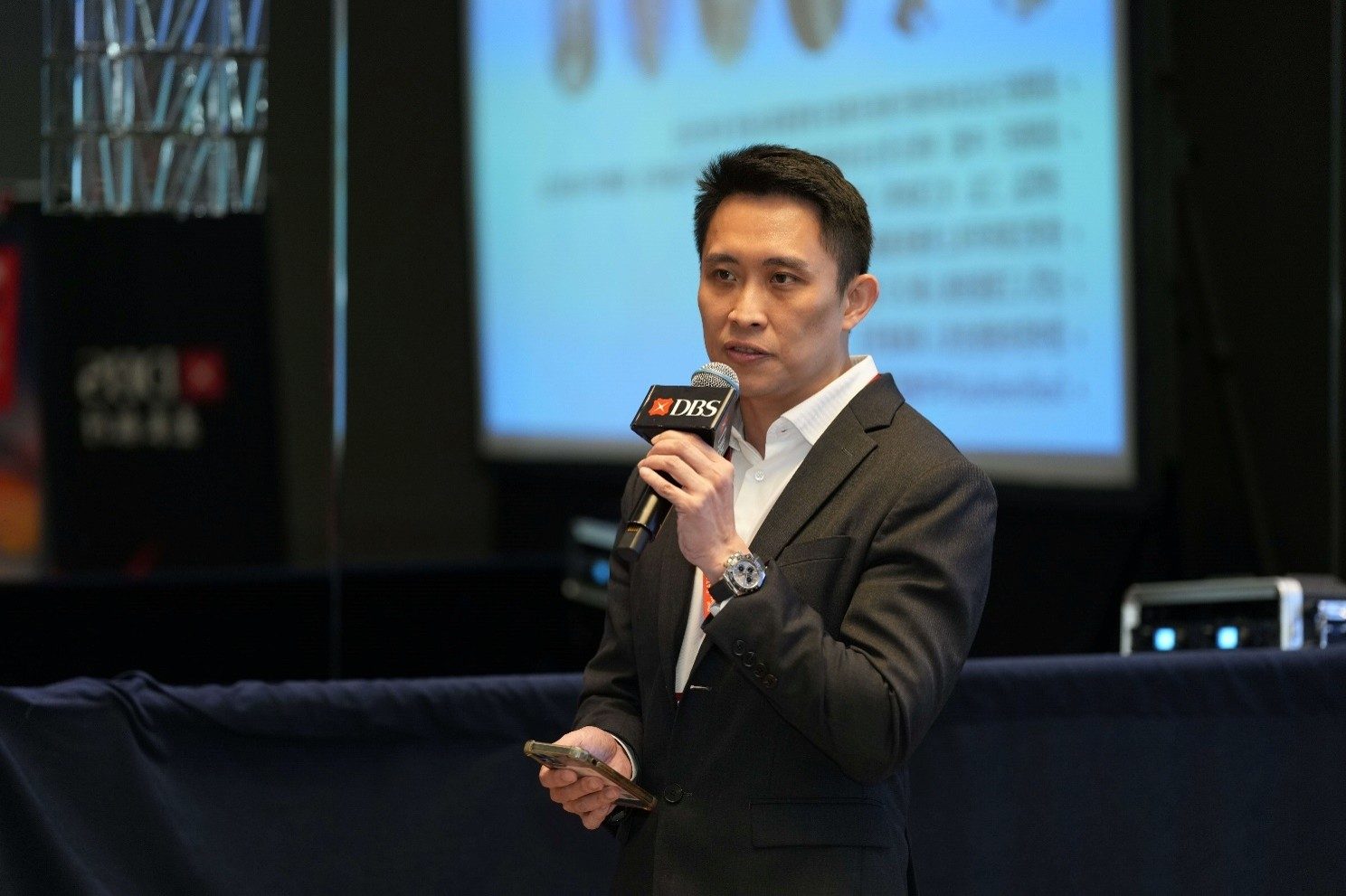
DBS Bank (Hong Kong) Limited under DBS Group, Asia’s leading multinational banking and financial services group, co-hosts a high-level, closed-door luncheon themed on “From fundraising to cross-border growth: Instilling resilience in China tech champions in an uncertain world” during DealStreetAsia’s Asia PE Leadership Summit in Hong Kong on May 20, 2026. Shih Guan Chua, Managing Director & Head of Digital Economy Group, Institutional Banking Group, DBS Bank delivers a keynote speech at the luncheon.
Amid reviving global interest, new-generation deep tech and artificial intelligence (AI) enterprises growing out of China is charting new paths for global market integration, navigating capital markets through institutional financial resilience.
During a closed-door luncheon sponsored by DBS Bank (Hong Kong) Limited under DBS Group – Asia’s leading multinational banking and financial services group – deep tech entrepreneurs, stock exchange executives, and fund managers converged to dissect the mechanisms behind this new growth paradigm for deep tech from China.
This luncheon, themed on “Instilling resilience in China tech champions in an uncertain world,” was set against the backdrop of a resurgence of market confidence.
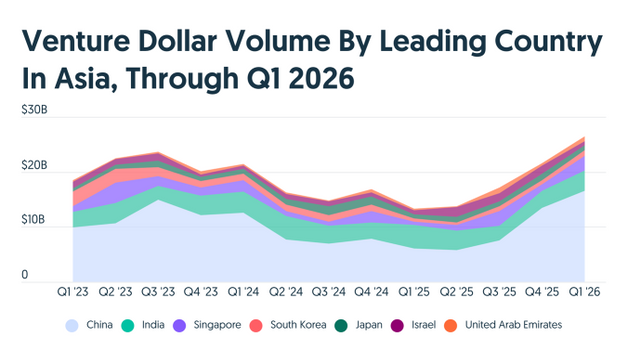
Globally, a record wave of big-ticket investments in deep tech and AI drove venture capital (VC) financing to a new high in the first quarter. This tech-driven venture funding gain was especially prominent in China, which booked an estimated $16.5 billion in Q1, or 60% of all startup funding across Asia, Crunchbase data shows.
Reflecting on the industry’s trajectory, the DBS luncheon featured five speakers, who expressed great optimism for the future of Chinese deep tech and averaged a confidence score of just over 9.1 out of 10.
Underneath market enthusiasm, the speakers highlighted the importance of building resilience through institutional financial frameworks, as Chinese tech founders and venture investors strategise fundraising and global expansion plans, fostering international collaboration and market reach.
The Digital Economy Group of DBS Bank is dedicated to supporting new economy and deep tech companies. Because of its deep understanding of this sector, DBS is able to offer tailored services to these fast growing companies and utilise non-traditional methods to offer credit solutions to these pre-profitable companies.
“We are willing to go deep to understand the business model to offer uniquely tailored solutions and build long-term relationship,” said the keynote speaker Shih Guan Chua, Managing Director & Head of Digital Economy Group, Institutional Banking Group, DBS Bank.
Chua said that DBS Bank’s deep global connections and market knowhow in Asia can help Chinese fund managers break ground and stay ahead as they build up USD practices and pan-regional footprints.
‘Global-from-day-one’ mandate
Although macro headwinds and challenges in commercialisation persist, market participants argued that structural tailwinds provide a firm bedrock for the long-term growth of Chinese deep tech.
For venture capitalists, their conviction to Chinese deep tech is forged from weathering prior cycles of obscurity.
“Over the past decade, deep tech founders and investors in China always took back-row seats. But today, with AI as a core engine driving its growth, deep tech industry leaders are at the absolute forefront of the global market,” said Haibo Yao, Founding Partner, Kinzon Capital.
Yao exemplified with the latest January 2026 Consumer Electronics Show (CES) in Las Vegas, the US, where Chinese companies accounted for over one quarter of the total registered exhibitors.
Robust policy frameworks embedded within China’s 15th Five-Year Plan (2026-30), which prioritises tech self-reliance and the so-called “new-quality productive forces (新质生产力),” have offered policy coherence that global observers see more clarity relative to nowadays Western legislative environments.
This policy continuity is coupled with China’s sheer size of its domestic market, dense talent pool, and absolute advantage in supply chain and AI infrastructure, such as data centres and renewable energy systems.
“This represents a rare opportunity of the era,” said David Chang, Executive Director & Head of Digital Economy Group, Auto and General Industry, Institutional Banking Group, DBS Bank (China) Limited. “Advanced manufacturing and deep tech companies are moving towards two directions: going global through profound operational strengths and through capital markets.”
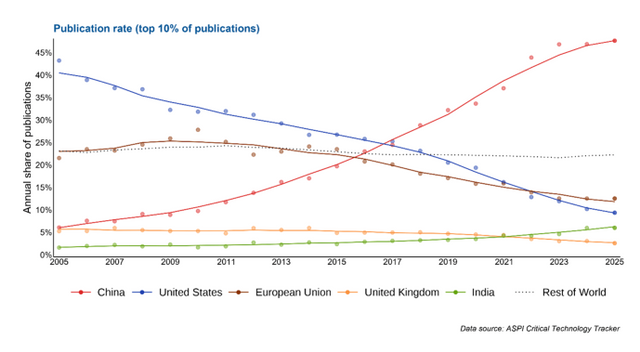
Moreover, despite China taking big strides in recent years and effectively leading in more critical tech areas than the US, a pronounced China-US tech valuation gap continues to exist. Chinese tech giants and AI startups often trade at a discount despite comparable revenue and user engagement profiles to their US counterparts.
“In general, Chinese tech enterprises are at a valuation trough relative to US peers, making them investment targets of greater value and with more room for growth. I believe capital markets will gradually recognise the potential of these undervalued assets,” said Shimu Wang, Founder & CEO, Seele AI.
To achieve the true value of Chinese deep tech, forward-looking AI founders are moving past standard export mentalities to operate under a “global-from-day-one” strategy.
“From day one, we are positioned as a global company,” said Wang, rejecting the popular notion of “going global.”
By scaling Seele AI’s zero-code, text-to-game and 3D interactive world generation business, Wang said that the startup already crossed $5 million in annualised recurring revenue (ARR) in the first five months of 2026, with the high-average revenue per user (ARPU) US market contributing to approximately 70%. As of present, the startup has a team of only 33 full-timers.
At its core, this “global-from-day-one” strategy enables AI-native developers with in-house multimodal large models like Seele AI to achieve commercialisation at the early stage – a critical metric for global tech investors who increasingly value proven business models and defensible cash flows.
Broadly, Chinese-led global pioneers, such as DJI, Anker Innovations, and Dreame Technology, are all shifting the narrative of Chinese products from low-cost manufacturing to international trendsetters. These tech companies are capturing the high-value market segments to build strong financial health.
Winning the known risks
As Chinese tech grows beyond domestic borders, founders and investors find themselves navigating a complex matrix of geopolitical, operational, cultural, and financial risks. While external factors remain hard to predict, financial and regulatory compliance risks can be reasonably managed if prioritised early.
“With rising global ambitions, we deeply felt that Chinese tech companies have shifted from ‘capital-driven’ to ‘commercial-driven’ growth in the past few years,” said Chang of DBS Bank (China) Limited.
Comparing to the traditional capital-driven growth that often prioritised burning cash for user acquisition over profitability, commercial-driven growth focuses on the allocation, efficiency, and return on existing capital to ensure sustainable value creation.
“Financial risks are known, measurable, and manageable,” said Chang. And steering clear of such risks to enable commercial-driven growth is precisely where multinational banks can play a crucial role.
Financial risks for global Chinese companies manifest in several areas: cash management, foreign exchange (FX) management, strategic advisory, early-to-Pre-IPO and M&A financing, capital markets access, credit solutions, and more.
DBS Bank is well-positioned to support companies in their global ambitions, said Chang. “In China, if your company is recognised by the nation as a sci-tech innovation ‘Little Giant (科创小巨人),’ you are often courted by numerous domestic banks offering generous credit lines, low rates, and fast-tracked procedures. And when you go overseas, you will realise what you very much need is a trusted partner to accompany you on your expansion journey.”
DBS Bank actively supports innovators and private capital in securing international funding and scaling their operations. The bank’s “One DBS” approach ensures comprehensive client support by seamlessly collaborating across specialised teams.
For instance, the Institutional Treasury Management team collaborates closely with the Digital Economy Group (DEG) to provide end-to-end banking solutions for fund managers at both the fund and SPV levels. They enable asset managers to establish and scale their offshore USD fund platforms through DBS’s integrated cash management, custody, FX, treasury, and Global Financial Markets (GFM) solutions, supporting their capital calls, investment activities, and operational needs.
Across public markets, institutional and retail appetite for AI, semiconductors, biotech, renewable energy, commercial aerospace, and advanced manufacturing is driving massive capital flows into future tech champions.
As the world’s biggest initial public offering (IPO) market, Hong Kong saw new economy sectors account for 66% of the $286.9-billion proceeds raised across 119 IPOs in the city last year. Among them included 21 listings under the exchange’s Chapter 18 series of listing rules for biotech and specialist tech companies, according to official data from the stock exchange operator, Hong Kong Exchanges and Clearing Limited (HKEX).
This tech-centric IPO momentum continues in 2026. As of late April, Hong Kong recorded a listing pipeline of over 500 companies, following notable Q1 activity by new issuers from TMT and across the AI value chain.
To achieve IPO targets and long-term refinancing across public markets, the speakers offered clear advice for companies and investors: select your advisor and sponsor carefully, invest sufficient time in IPO preparation, and avoid rushing to the market just to catch a perceived listing window.
By prioritising commercialisation, early compliance, and sophisticated cross-border banking infrastructure, globally-minded emerging Chinese deep tech players can successfully convert macro volatility into long-term organisational resilience.