Partner content in association with
How Wood Mackenzie helps to factor in the hidden costs of APAC’s data centre boom


Headline numbers on data centre investment mask the disparity between projections and reality.
As much as $31.6 trillion in data centre investments is being projected globally through 2050, and annual data centre capex is expected to rise from $800 billion in 2026 to $1.8 trillion in 2050, according to a recent report from PwC.
While the US is likely to account for nearly half of this expenditure, the APAC region could corner $8.2 trillion in cumulative capex led by China and India, per the report. Across Southeast Asia, too, data centre investments have galvanised an otherwise conservative deal market.
There were two outsized billion-dollar funding rounds over two successive quarters: a $1.3 billion investment in Princeton Digital Group by Stonepeak in Q4 2025 and, in Q1 2026, a $2 billion Series C investment in DayOne Data Centre by Coatue and Indonesia Investment Authority, among other investors, according to DealStreetAsia.
While traditional infrastructure investments tend to rationalise after a massive build-up, data centres continue to be an investable opportunity for several reasons. These include the growing adoption of AI, data privacy norms around storage, the prevalence of cloud-based services, and the need for faster chips and equipment upgrades.
In many Asian markets, data centres are a key battleground in the clash between American hyperscalers including AWS, Google, Microsoft, and Oracle, and Chinese tech giants such as ByteDance and Alibaba.
Wood Mackenzie, a global data and analytics company for the energy industry, has tracked over 60 GW of data centre capacity that is being planned for the APAC region.
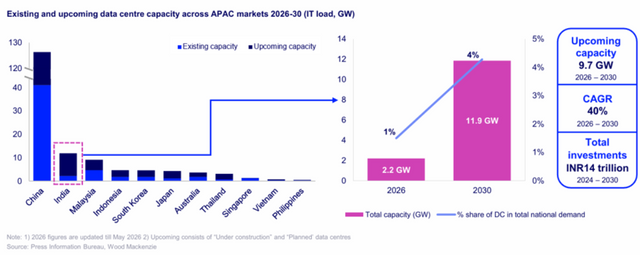
However, amid optimism about a potential gold rush, there is a dawning realisation that not all investments are created equal.
Data centre investment projections do not match ground reality
Only 37% of the over 60 GW tracked pipeline has been assessed by Wood Mackenzie as highly likely or post-FID (final investment decision)—the execution phase of a project.
Over half the proposed capacity faces one or more material deliverability risks. These include:
- Speculative hoarding of grid connection queues
- Lack of substation capacity
- Insufficient power supply
- Absence of credible green energy procurement pathways
- Overbuild risk amid uncertain AI demand.
Describing the deficit, Joshua Ngu, Vice Chairman, Asia Pacific at Wood Mackenzie said, “There is a lack of clear and robust information about power in general. We are expecting growth of about 230 GWh over the next few years; equivalent to the total consumption of Japan alone.
The build-out of power supply is a huge concern. There are several constraints on the supply chain, including transformers, gas turbines, and other ancillary services.
Even in a relatively mature market like the US, the challenge is to make a judgement with regard to which data centres will be developed and when they are likely to be operational. The need of the hour is to have a holistic view of the interconnections between different elements across the ecosystem to grasp the bigger picture.
Some of the most pressing questions include:
- Can a new power plant be built, or is the current capacity sufficient?
- Does the regulatory structure within a particular country allow for fast-track development of new power projects?
- Are the right policies in place to procure power, and at what price?
How Wood Mackenzie builds a complete picture around data centre risk
Understanding this complexity requires looking beyond individual developments and seeing how the different parts of the energy system interact. Wood Mackenzie combines market research, data, technical expertise and on-the-ground insights to track the factors shaping markets across commodities and geographies.
By connecting these signals, it provides a complete picture of how changes in policy, infrastructure, technology, supply and demand can influence one another. Wood Mackenzie has tracked 4,200 data centres and large load projects globally across 27 countries.
Speaking of the offering, Ngu said, “Our unique insight into the global and cross-industry picture enables us to bring all this insight together to make a well-informed judgement about which projects have a better chance of being FID.”
Such granularity helps investors get a more nuanced view, revealing gaps that siloed insights from a specific industry or regional perspective often obscure.
For instance, viewing India as a homogeneous market is a reductive approach. According to Wood Mackenzie’s analysis, India’s data centre opportunity is six distinct state stories with very different economics. It’s necessary to compare incentives such as electricity duty exemptions, stamp duty waivers, land subsidies, and essential service status across these states before determining the one that stands out. For example, Wood Mackenzie discovered that in the southern state of Andhra Pradesh, savings from open-access power purchase agreements are similar to self-generated power, a difference not seen at the national level, but important for project returns.
Wood Mackenzie’s local teams conduct real-time monitoring of policy changes that could impact development. Ngu said, “We determine if there’s a need to remodel the markets to give a view in terms of changes. The other part is efficacy. We support governments in how they should think about policy. We can demonstrate what the impact could be, the pros and cons, and the likelihood of a policy change achieving an intended outcome. Our approach combines subject matter expertise with models that back up an outcome from a quantitative perspective.”
How investors can identify the right data centre bets
Information from Wood Mackenzie allows investors to fast-track potential acquisitions or partnerships. Once a decision has been made about a particular asset, Wood Mackenzie conducts due diligence, running different scenarios to understand power pricing, thus helping all the way from starting a deal through to the sales and purchase agreement ( SPA) process.
Common green flags that potential investors should look for include a project at an advanced stage, with permissions and power purchase agreements in place. However, the market for such projects is very competitive.
The fundamental questions for early investors should be whether the regulatory environment is supportive of data centres, power projects, and power procurement. Approvals around power supply availability and being able to secure PPAs are particularly important in markets across Asia, which tend to be either regulated or semi-regulated; Singapore and Japan being the only notable exceptions.
Against the backdrop of discomfort around the establishment of data centres in certain geographies, Wood Mackenzie’s recent acquisition of Landgate further signals its commitment to proprietary data. Currently prevalent in the US, LandGate tracks the willingness of landowners to have data centres and power infrastructure, including wind and solar, on their properties. “The investments we are making will help clients understand the locations that are most beneficial for data centre development. Not just which city or county, but down to which tract of land,” Ngu said.
As the data centre super cycle accelerates, the margin for error in capital allocation is narrower than ever. Top-line projections and isolated sector-specific insights and publicly scraped data alone present a limited, and therefore risky view.
Wood Mackenzie combines localised regulatory expertise, real-time commodity modelling and proprietary land data to equip investors with a comprehensive view of facts, grounded in evidence, enabling them to deploy capital with confidence.