
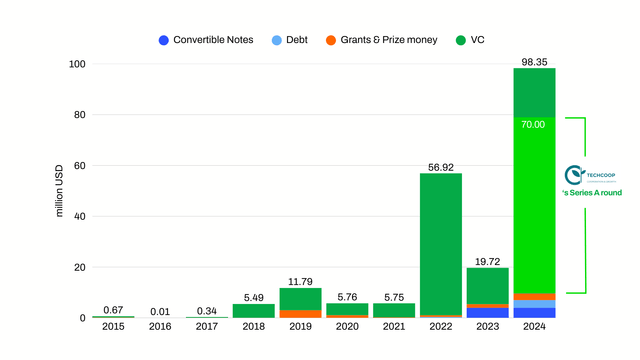
Vietnamese climate tech startups had a standout year in 2024, having raised $98.4 million across 55 transactions, according to the Vietnam Climate Tech Funding Ecosystem 2025 report by New Energy Nexus and RMIT University.
The financing value surged nearly five times compared to 2023, and surpassed an earlier high of $57 million in 2022.
Venture capital (VC) funding made up the highest share of total funding value, reaching a record $88.75 million last year.
This momentum boosted climate tech deals to represent 22.3% of total VC funding in the country, almost doubling the global climate tech VC share of 12%.
However, the headline figures mask the sector’s fragile maturity stage. Despite the broader long-term uptrend in VC funding, the increase in total VC funding remains dependent on a small number of mega-deals, with a striking 71% of 2024 funding originating from just B2B agritech platform Techcoop’s $70-million Series A round.
This trend continued in the first 10 months of 2025, according to DealStreetAsia’s DATA VANTAGE, which shows that climate tech funding in Vietnam reached nearly $24 million, but electric vehicle maker Dat Bike’s new investment round alone accounted for $22 million.
The sector’s nascent stage is further reflected in the low post-seed graduation rate, which stood at only 11.1% for climate tech in 2024, far below the 32.2% rate for the wider tech sector, a widening gap seen since 2022.
The report identifies key barriers, including high capital expenditure requirements and the difficulty many local startups face in demonstrating expected growth trajectories. In addition to environmental and social impacts, investors evaluate whether a deal can unlock larger pools of capital. Respondents noted that businesses tend to react to short-lived market trends, and cross-border frictions, especially around ESG standards, added to the challenges.
That said, investor interest has deepened in the sector. The number of impact investors participating in climate tech deals in Vietnam increased from just one in 2020 to 10 in 2024, the report showed.
This growth has been driven by two parallel trends: mainstream venture capital funds integrating sustainability into their investment strategies, such as Touchstone Partners, and established impact investors like Beacon Fund, Clime Capital and Aavishkaar Capital expanding their regional mandates. Private credit and hybrid solutions have also gained momentum over the past two years.
Underlying these developments are the significant opportunities created by Vietnam’s acute climate vulnerability. The country faces rising sea levels, saltwater intrusion, and extreme weather events that threaten its economic stability and food security. The World Bank estimates that climate impact could cost Vietnam up to 14.5% of GDP by 2050.