There are plans to file a new police report in Singapore against the co-founders and former directors of embattled aquaculture startup eFishery, according to documents seen by DealStreetAsia, adding to similar filings in Indonesia.
The new allegations claim the founders were responsible for losses at the company amounting to 4.1 trillion rupiah ($253 million).
According to the planned report, former CEO Gibran Huzaifah and former chief product officer (CPO) Chrisna Aditya Wardani are alleged to have violated Singapore’s Companies Act, as well as potentially breached the country’s Penal Code for fraud, specifically for knowingly causing wrongful loss to individuals whose interests they were duty-bound to protect.
The report, prepared on behalf of Singapore-registered eFishery Pte. Ltd, alleges that Gibran inflated eFishery’s financials, including revenue, cost of goods sold, gross margins, pre-tax profit, and rented feeders through a dual reporting system; and misrepresented the company’s financial performance to its board of directors.
The document also alleges that former CPO Chrisna was aware that inflated financials were being presented to the board, was in attendance during those meetings, and chose not to inform the other directors about the inflated financials. As such, he is alleged to have breached his statutory duties to eFishery and abetted Gibran’s actions.
As a result of the alleged misrepresentation of financials and company performance, the report said some 4.1 trillion rupiah in capital in the form of cash and convertible loans were injected from the Singapore-registered eFishery into the Indonesian entity, which were likely used for its operating needs.
“Had eFishery not been so deceived, it would not have made the aforesaid capital injections,” the complaint said.
These alleged actions constitute potential offences under Singapore’s Companies Act and Penal Code, the report stated, including cheating, forgery, falsification of accounts, and being part of a criminal conspiracy.
As previously reported by DealStreetAsia, eFishery’s management had been maintaining two sets of accounting records. The ‘internal’ set of books were for the company’s leadership and an ‘external’ set for external stakeholders that showed inflated revenue and profit, creating a misleading narrative.
A forensic audit by FTI Consulting, appointed by eFishery’s board, found that, based on these inflated figures, the company had accumulated losses of approximately $152 million from its inception until November 2023.
In his first statement to the media since DealStreetAsia broke the story on the alleged fraud at eFishery in December, Gibran told local outlet Kontan earlier this week, “What I did in regards to the dual reporting was wrong. However, I have never misappropriated funds, not a single penny.”
Increasing salaries and bonuses
The inflated financial performance helped eFishery raise $314 million from investors at expanding valuations. In July 2023, it raised $200 million in its Series D round, at a ‘unicorn’ valuation of $1.35 billion.
Over the startup’s 10-year history, the founders also saw their compensation rise steadily.
In 2018, allegedly when Gibran first inflated eFishery’s financials, his gross monthly salary stood at 28.9 million rupiah. The following year, it increased to 44.3 million rupiah and continued to rise steadily over the years. By 2024, his monthly salary had surged to 1.28 billion rupiah, reflecting a dramatic escalation in compensation along with the company’s growing valuation.
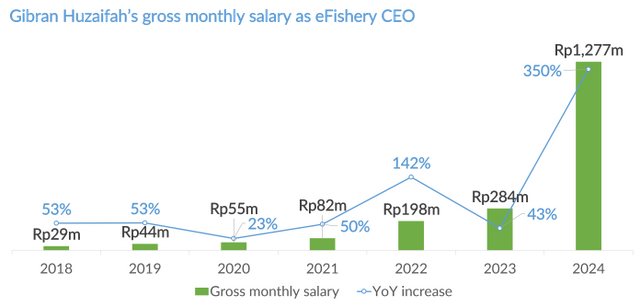
Due to the misrepresentation of financial figures, eFishery approved a cost structure based on inflated data, which then impacted various cost items, including employee bonuses. In 2023, for instance, there was a payout of 24.4 billion rupiah for performance — an increase of 98.4% compared to the previous year, of which 669 million rupiah was transferred to Gibran.
On top of the salaries and bonuses, eFishery entered into a share buyback agreement with Gibran and Chrisna in August 2023, under which the company paid each of them $999,999.11 in consideration for the repurchase of 79,423 ordinary shares. The transaction took place shortly after the completion of eFishery’s Series D round in July, which valued the company at $1.35 billion and set the price for its preference shares at $14.39 apiece.
The planned police report also states that had eFishery’s board been aware of the company’s true financial position at the time, it is likely that they would not have proceeded with the share buyback transaction or continued paying salaries and bonuses to Gibran and Chrisna.
Prior to the buyback, eFishery’s corporate filings in Singapore reveal that in September 2020, shortly after completing its Series B funding round in August, Gibran transferred 390 ordinary shares to 12 entities, including those linked to Aqua-Spark, Endeavor, and Wavemaker Partners.
Separately, Chrishna also transferred 390 ordinary shares to four entities, among them Wavemaker Partners and its joint venture with the World Bank’s International Finance Corporation. These transfers took place between September 2020 and July 2021.
DealStreetAsia has not been able to determine the value of these transactions. By the time of its Series C fundraising in 2022, eFishery implemented a stock split, increasing the number of ordinary shares by a factor of 1,000.
Gibran and Chrisna maintain their ownership in eFishery, holding 8.5 million and 8.2 million ordinary shares, respectively, representing stakes of 9.02% and 8.74% in the company.
Under-developed technology
Gibran’s entry into aquaculture began during his university years at the Bandung Institute of Technology (ITB), where he pursued a degree in Biological Science. He initially founded Dorri Foods Indonesia, a catfish farming and processing business, in 2009. That experience shaped his understanding of the industry’s inefficiencies, leading him to envision a more sustainable and scalable solution.
In 2013, Gibran co-founded eFishery, with Chrisna, an electrical engineering graduate from the same alma mater, joining in 2015. Together, they developed eFeeder, an automated smart feeding system designed to improve efficiency in fish and shrimp farming. On paper, the technology leverages IoT, sensors, and data analytics to optimise feeding, minimise waste, and enhance overall farm productivity.
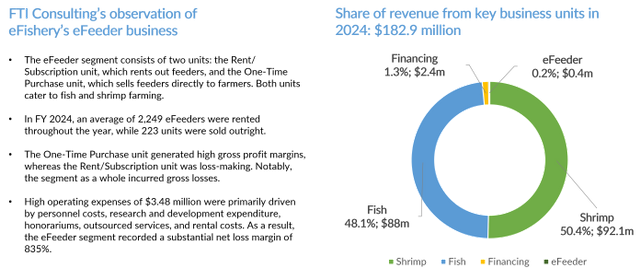
The forensic investigation by FTI Consulting, however, found that the eFeeder technology has failed to deliver on its promise. It lacks in-water sensing devices to capture and relay crucial pond activity data, effectively rendering the system inoperative and forcing the company to rely on manual labour to compensate for its shortcomings.
This reduces eFishery to a traditional service provider across the cultivation cycle, leading to severe financial repercussions, according to FTI.
Despite its under-developed technology, but backed by investor capital, eFishery aggressively expanded into multiple business segments, positioning itself as an end-to-end platform connecting farmers with upstream suppliers, downstream buyers, and financial institutions for cultivation financing through partnerships with fintech lenders including Amartha, Kredivo, and Julo.
These segments, traditionally characterised by low margins and high risk, eroded profitability, leading to sustained financial losses over the years.
With the company’s resources stretched across multiple business segments, only $8.5 million was allocated to technology development, just 2.7% of the $314 million raised from investors. According to the company’s 2024 financial performance, the eFeeder segment generated just $439,000, accounting for a mere 0.2% of total annual revenue.
Future still in doubt
Reeling from the revelations about the years of alleged financial data misrepresentations and mounting losses, eFishery shareholders have yet to decide what to do with the company.
An independent business review by FTI, based on its forensic financial audit, concluded that the company faces two options. It should either wind down operations within six months, or undergo a restructuring and review process, each with its own implications.
If the company opts for a wind-down, investors could recover remaining assets in Indonesia, estimated between $39.3 million and $42.7 million. This process would require further downsizing, retaining only essential staff in finance, legal, and debt collection functions.
The wind-down option would also entail further investigations into potential financial leakages to trace and recover assets. This process may include legal action against the founders, as well as negligence lawsuits against eFishery’s financial auditors. The companies which audited and signed off on the company’s financial reports over the years that contained inflated figures include Crowe, PwC, and Grant Thornton.
DealStreetAsia has contacted the auditors for comment.
According to FTI’s investigation, eFishery’s auditors were not granted access to the company’s internal accounting records. For transactions selected for sample testing, if they were fictitious, the management allegedly fabricated supporting documents. Employees were reportedly instructed to use tools like Adobe’s image editing software to modify records, ensuring that external financial reports aligned with the manipulated figures.
Editor’s note: This story has been corrected following updates that DealStreetAsia received regarding a company extraordinary general meeting.