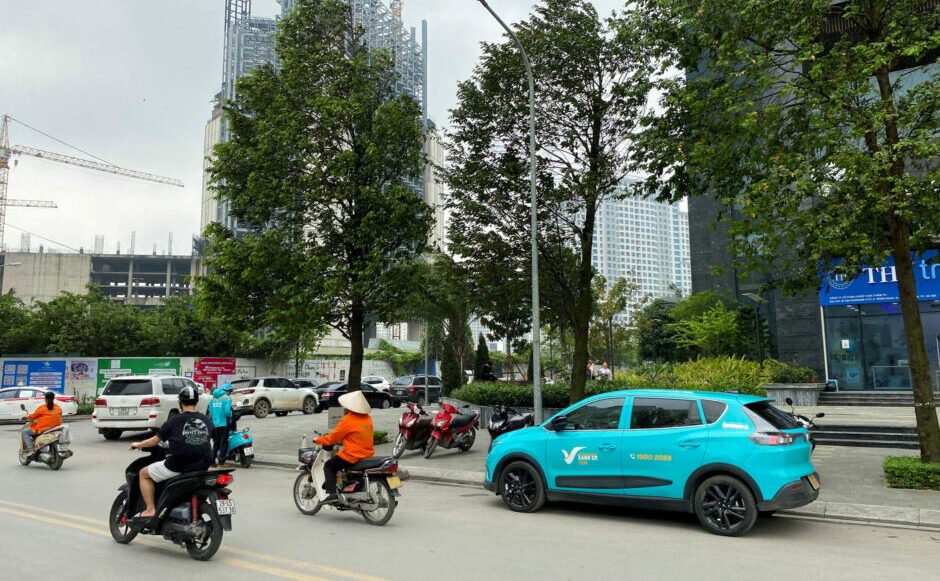
Hanoi will phase out gasoline and diesel taxis by 2030, as part of its push into green urban transport. Meanwhile, the capital city has also rolled out the Hanoi Innovation Centre (HIC) as it positions itself as a regional innovation hub.
Hanoi plans all-electric taxi fleet by 2030
Hanoi will phase out gasoline and diesel taxis by 2030, as part of its push to green urban transport, local media reported.
In a plan issued on February 27, the city’s People’s Committee set a roadmap for the transition, targeting 63-64% of taxis to run on electric or other green energy by 2026, rising to 68–70% in 2027, and reaching full transition by 2030.
The plan includes phased support policies for operators and proposals to curb high-emission vehicles.
Authorities will draft a resolution for the city’s People’s Council to back the shift, including measures to restrict polluting vehicles and a proposal for higher authorities to extend registration fee exemptions for electric and green-energy cars, particularly those used for taxi services.
From the post‑2030 period, the city will focus on completing and sustaining stable operating conditions for electric and green‑energy taxis, prioritising enhanced access to charging infrastructure, designated stopping and parking points, and traffic organisation that is suitable for the operational characteristics of electric and green‑energy vehicles.
Hanoi rolls out innovation vehicle
Vietnam’s capital city has officially launched the Hanoi Innovation Centre (HIC) as it steps up efforts to position itself as a regional innovation hub.
Established through a joint investment between Hanoi, CMC Corporation and Hanoi University of Science and Technology, the centre is designed as a platform linking data, policy, capital and technology to address urban challenges and bolster the national innovation ecosystem.
The launch comes as Vietnam accelerates digital transformation amid rapid urbanisation. Officials expect HIC to support the growth of the digital economy and creative industries rooted in Hanoi’s cultural identity.
HIC outlined three strategic pillars: attracting global innovators to solve real urban issues such as congestion and environmental stress; strengthening international linkages, including encouraging overseas Vietnamese entrepreneurs to return; and fostering tripartite collaboration between government, academia and the private sector.
To execute its strategy, HIC has rolled out a four-stage incubation model.
The first stage connects public- and private-sector problem statements with innovation talent from universities, research institutes and overseas Vietnamese networks.
The second focuses on R&D and building minimum viable products, with AI tools deployed as a “co-founder” to streamline market research, business planning, coding and testing, shortening development cycles and lowering costs.
The third supports company formation through legal advisory, IP registration, shared digital infrastructure and access to regulatory sandboxes.
The final stage drives commercial acceleration, backed by venture capital and public-private partnerships.