
Southeast Asia’s growth is still running ahead of inflation, and its demographics remain favourable, but the region must build larger, more technically driven companies to produce more technology champions, Asia Partners co-founder and managing partner Nick Nash said.
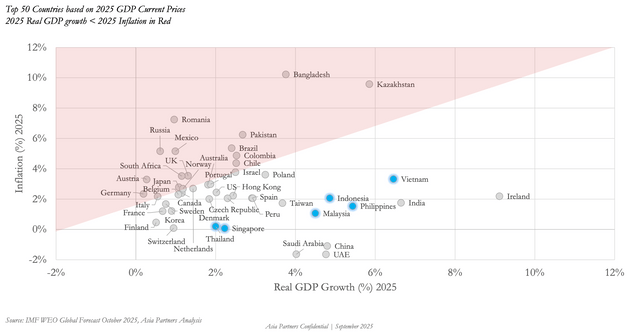
Speaking at DealStreetAsia’s Indonesia PE-VC Summit 2026, Nash said a growth-versus-inflation framework shows most of Southeast Asia sitting in what he described as a “very benign category” compared with many major economies.
“You want to have your growth rate be faster than your inflation rate,” he said. “We are very lucky that almost all of our entire region falls in that category.”
The demographic picture adds to that advantage, he said, highlighting Indonesia’s younger population profile relative to many countries in Asia.
Southeast Asia’s working-age population, he said, gives the region an opportunity to “follow in the footsteps of our neighbours to the north”, providing a longer runway for consumption growth and capital formation.
Yet, Nash said the region is underperforming in turning those tailwinds into technology companies of meaningful scale.
He pointed to a ranking of Southeast Asia’s largest listed firms by market capitalisation and noted that only two next-generation Internet companies appear among the top 35.
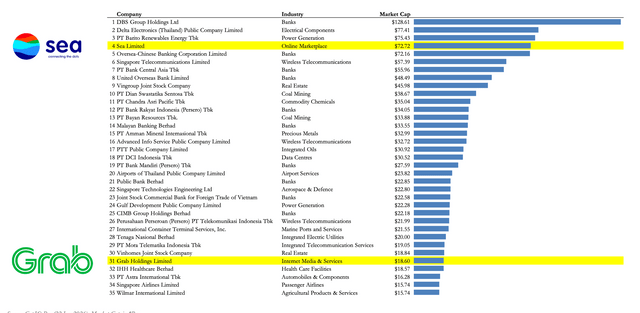
“Although we have two companies now… why are there just two?” he said, contrasting the outcome with markets such as the US, China, Japan, South Korea, and Taiwan, where technology firms dominate market leaders.
“That is actually underperforming relative to where our region should be,” Nash added, arguing that fixing the gap requires action not just from founders, but also from capital providers and regulators.
Part of the explanation, he said, lies in global capital cycles. Emerging markets peaked around October 2007 and have since been “a terrible disappointment to global investors” relative to developed markets.
But Nash said cycles can reverse through what he called “one of the most powerful forces” in markets: mean reversion.
“The dollar is now falling again. Commodity prices… are now rising again,” he said, adding that a major technology downturn in Western markets would complete the historical pattern that previously favoured emerging markets.
Even so, he cautioned that a more benign flow environment would not be enough on its own.
“That is not enough to drive success,” Nash said. “That simply drives a more benign perspective and fund inflows into our region.”
Nash said Southeast Asia’s startup ecosystem has spent too much of the past two decades assuming that e-commerce, retail, and consumer models are the only viable paths to scale.
“We have to revisit our assumption of the last 20 years,” he said. “We have to go back to the tech in tech and invest in more technical business models.”
He linked that shift to talent development, arguing that while the region has deep potential, it does a poor job identifying it early.
Citing international biology, physics, and chemistry Olympiad results, Nash said: “We have incredible talent in Southeast Asia, but we do a poor job of identifying them at a young age.”
Nash also said the market environment has fundamentally changed how companies are valued and financed. In a low-rate world, firms could list on revenue or even gross merchandise value multiples, but that era has passed.
“Turning up the temperature changes things,” he said, arguing that investors are now focused on nearer-term profitability and cash flow rather than long-dated narratives.
The central prescription, Nash said, is scale. Drawing on global data, he argued that larger companies consistently command higher valuation multiples across revenue, EBITDA, and cash flow.
“Bigger translates into higher value,” he said. “And it is not because these are monopolies. The rest are just bigger.”
That shift has coincided with a sharp slowdown in IPOs, particularly among small and mid-sized listings.
Nash said Southeast Asia has too few companies above roughly the $4.6-billion market-cap threshold needed to attract sustained institutional interest, contrasting the region with Japan, which has a similar GDP but far more companies above that level due to decades of consolidation.
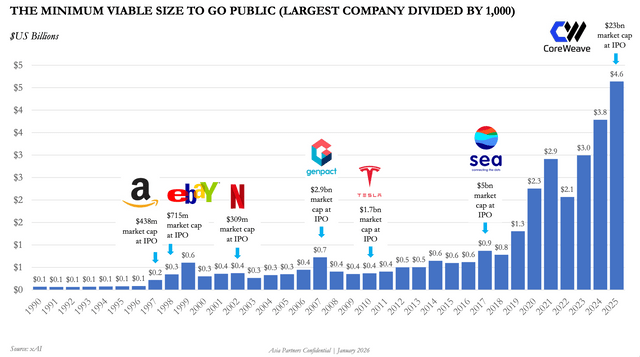
To close the gap, he urged founders to build regional businesses earlier, pursue mergers and roll-ups where markets are fragmented, and expand ambitions beyond single-country strategies.
He closed with a metaphor from his presentation: “You can make wine out of grapes,” he said, “or you can pick a larger fruit and make wine out of watermelons.”